

A retail store daily checklist lists the checks a store repeats every trading day, from the first unlock to the last lock. Finding one is easy. Making one that gets finished is harder, and it depends on three things: the list is short enough to finish, every check has one owner, and “done” leaves something a manager can see. This guide gives eighteen checks in three rounds, six each, then the rules that keep them working.
The opening and closing rounds of this retail store daily checklist are short versions. Our retail store opening and closing checklist has the full template, and our retail store checklist covers merchandising, stock and staff beyond the daily round.
What belongs on a retail store daily checklist
A check belongs on a retail store daily checklist only if three things are true. Skipping it can cost money or safety the same day. It takes minutes, not an hour. One person can finish it alone. A check that fails the first test is weekly or monthly. A check that fails the second is a project. A check that fails the third needs a second person, so make it a task with an owner and a time.
The cards below sort common checks by how often they come back. If the daily card grows past about eighteen lines across the day, something on it belongs on another card.
For the weekly and monthly routines in more detail, see our retail operations guide.
Opening checks: before the first customer
The opener owns this round, and it takes about fifteen minutes. The aim is to find anything that would stop a safe, correct first sale before a customer walks in. Each line should leave something a manager can see later, such as a tick with a name, a number, a time or a photo.
Walk the entrance and the glass before you unlock. If a door or window looks forced, do not go in: call your manager and the police.
Push open each exit door from inside and check the route behind it. Door and route must both be clear.
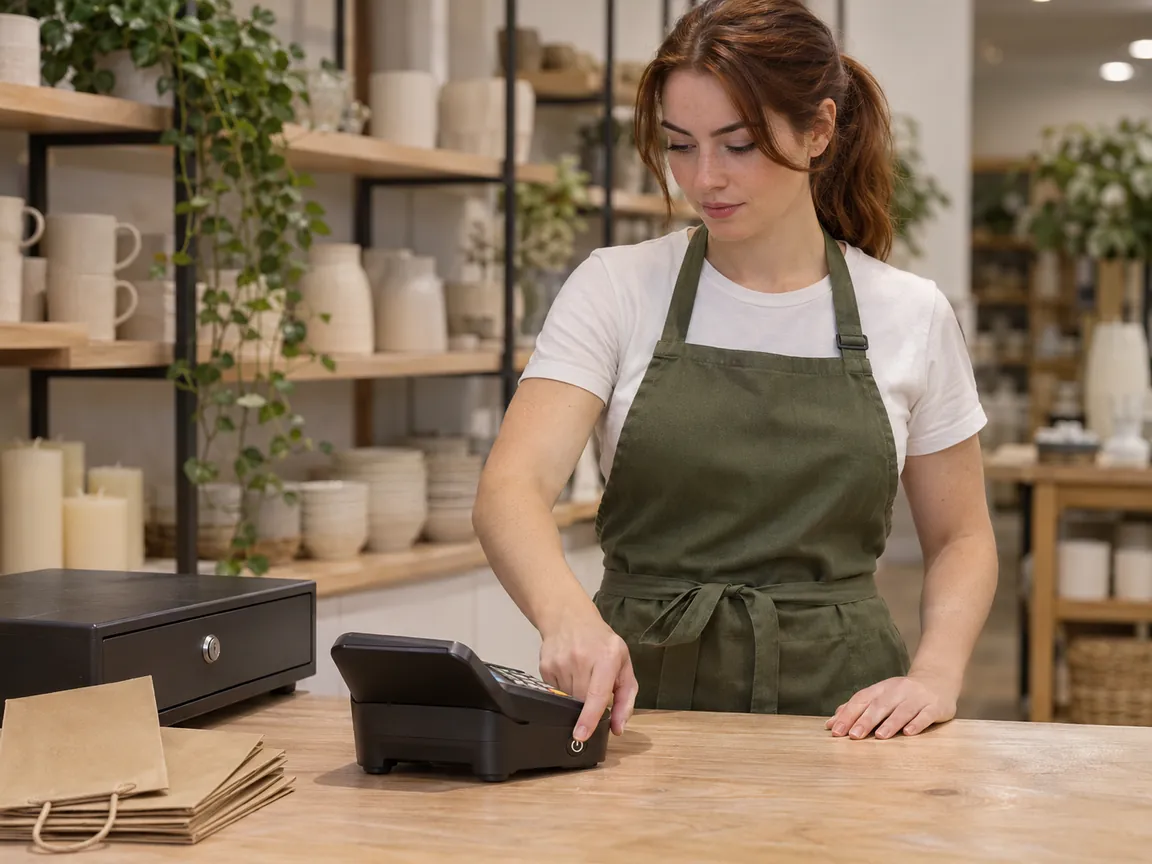
Count the float, write the amount down with your name and run one test sale on the card terminal.
Walk the front of the store as a customer would: clean glass, a dry floor and a clear path to the first display.
Check that today’s promotion labels are up, match the offer and sit next to the right product. Take down labels for offers that ended.
Read yesterday’s closing note. Give every open item an owner and a time before the shift briefing.
That is the whole opening round. The longer version, with the exit-route rules and the float handover, is in the free template below, as a PDF and an editable spreadsheet.
The mid-day round: a loop through the store
A retail store daily checklist that stops at opening and closing misses the part of the day when customers are in the store. That is where order slips. Run the round as a loop in the same order each time, at fixed times: once before lunch and once mid-afternoon, plus a third pass before an evening rush in busy stores. If the mid-day loop takes longer than about twenty minutes, move something to the weekly list.
Entrance and checkout. Glass clear, mats flat, counter free of clutter and the queue path open.
Fitting rooms and restrooms. Empty, clean and stocked. Take stray items back to the sales floor.
Sales floor. Pull stock to the front edge, refold or rehang and fill gaps on top sellers first, as in shelf replenishment. Reset the front table.
Prices and promotions. Check ten items against the price list. Photograph any label that does not match, then fix it.
Safety. Look for spills, loose boxes, cables and blocked routes. Make each one safe at once and write down what you found.
Back door. Count each delivery against the order and note shortages and damage before you open cartons, as in the goods receiving checklist. Log damaged stock with the damaged goods procedure.
Write down the time the loop started and the time it ended. A skipped round then shows as a gap in the times instead of a surprise at closing. The safety stop is in every loop for a reason: in the US, OSHA’s walking-working surfaces rule says floors must be kept clean and, to the extent feasible, dry, and that walking surfaces must be free of hazards such as leaks and spills (29 CFR 1910.22).

Closing checks: after the last customer
The closer owns this round. Work in an order that ends at the door: people out, cash counted, floor reset, then lock up and write the note. Each line leaves a number, a time or a note for the opener to read.
Confirm the last customer has left, then lock the doors behind them. Check the fitting rooms and restrooms for people and left items.
Count the cash drawer against the register total and note any difference, however small, with your name.
Put the takings in the safe or the bank bag under your cash procedure, and note who did it.
Put the floor back the way tomorrow’s opener should find it: stock on shelves, fronts faced, front table reset.
Check the exit routes after the last delivery or cardboard run, then switch off equipment and extra lights.
Lock up, set the alarm and write down the time. Write the closing note: open issues, deliveries not put away and promotion changes for tomorrow, each with an owner.
The opener starts tomorrow from this note, so write it for someone who cannot ask you questions. If a different team takes the next shift, our shift handover checklist shows how to pass on whatever is still open.
Give every check one owner and one proof
A check with two owners has none. Name an owner by role, not “the team”: the opener for the first round, one named person on each shift for the mid-day round, the closer for the last, and the manager on duty for the list itself. That manager also decides what moves when the day goes wrong. Then give every check one proof, so “done” leaves a record.
| Proof | Use it for |
|---|---|
| Tick | Quick look-over checks, such as exit routes clear or fitting rooms empty. Add a name and a time, or it is only a habit. |
| Number | Anything with a figure: the float, the closing cash difference, a fridge reading. A written number can be compared tomorrow, and a tick cannot. |
| Time | Anything that must happen at a set moment: doors locked, alarm set, the mid-day loop started and finished. |
| Photo | Anything judged by how it looks: a promotion label next to its price, the front table once reset, a hazard you want fixed. |
Ask for the lightest proof that settles the question. A photo on every line slows the round, so keep photos for the lines where a tick would leave an argument. Write what “done” looks like once for each check, as our retail SOP guide shows.
What to do when a check is missed
Every store misses checks, and a retail store daily checklist should say what happens next. What hurts is a silent miss, so decide in advance what a miss becomes. The person on shift should not have to settle it under pressure while the queue grows.
Some checks never move: exit routes, spills, doors and alarm, the float and the closing cash count. If the shift is short, those are done first. Everything else moves to the next round or the next shift as a task with an owner and a time, agreed by the manager on duty. Our retail task prioritization guide shows how to decide what moves when the shift gets busy.

Count misses, not ticks. If the same check is missed three days in a row, the check, the owner or the time slot is wrong. Change one of them instead of sending another reminder. Raise repeated misses on the next store visit; our audit frequency guide shows how often to visit.
What to add for your store type
The core list works in any store. Each format adds a few checks of its own, and each should pass the same three-part test.
Fashion and apparel
Add the fitting rooms to every mid-day loop, emptied and rehung each time. Check that the front table and the window match the visual merchandising brief, and that size runs on top sellers are complete. Our guide to fashion retail visual merchandising covers the brief.
Grocery and fresh
Add fridge and freezer readings, written down at set times. Pull short-dated stock, fill gaps in fresh before the peak and keep the entrance dry in wet weather. Our supermarket store operations guide covers each department.
Drugstores and beauty
Add a short-dated stock check on fast sellers, promotion labels matched to the offer and testers kept tidy and stocked. Photograph each finished promotion display, so merchandising feedback reaches the person who built it the same day.
Home and DIY
Add tall fixtures and outdoor displays: secure, stable and clear of the walkway, with heavy items on low shelves. Wide aisles collect loose packaging and pallets, so keep the safety stop in every loop.
Run your retail store daily checklist across many stores
On paper, a daily checklist works in one store. Across twenty stores the question changes: did every store do it today, and what happened to the checks that failed? Bitreport turns the checklist into a recurring task. It repeats daily, weekly or on whatever schedule you need, staff get the structured checklist in the app, and every step is confirmed, with photos uploaded and everything time-stamped. Our recurring workflows page shows how that works.
Managers see which stores are consistent and which are not without asking, and they see task status across all locations. Each task tells staff what to do, by when and which photo proof is required, as our task management page describes.
Bitreport does not count your cash or keep your stock records. The register, the safe and the inventory system stay where they are. Bitreport adds a record that the checks were done, and of what happened to the ones that failed. For more on checklists in an app, see our guide to digital retail operations checklists.
Frequently asked questions
What should a retail store daily checklist include?
A check belongs on a retail store daily checklist only if three things are true. Skipping it can cost money or safety the same day. It takes minutes, not an hour. One person can finish it alone. This guide gives eighteen checks in three rounds, six each, then the rules that keep them working.
How long should the daily checklist be?
If the daily card grows past about eighteen lines across the day, something on it belongs on another card. If the mid-day loop takes longer than about twenty minutes, move something to the weekly list.
Who should own the daily checklist?
A check with two owners has none. Name an owner by role, not “the team”: the opener for the first round, one named person on each shift for the mid-day round, the closer for the last, and the manager on duty for the list itself. That manager also decides what moves when the day goes wrong.
What should happen when a check is missed?
Some checks never move: exit routes, spills, doors and alarm, the float and the closing cash count. If the shift is short, those are done first. Everything else moves to the next round or the next shift as a task with an owner and a time, agreed by the manager on duty.