
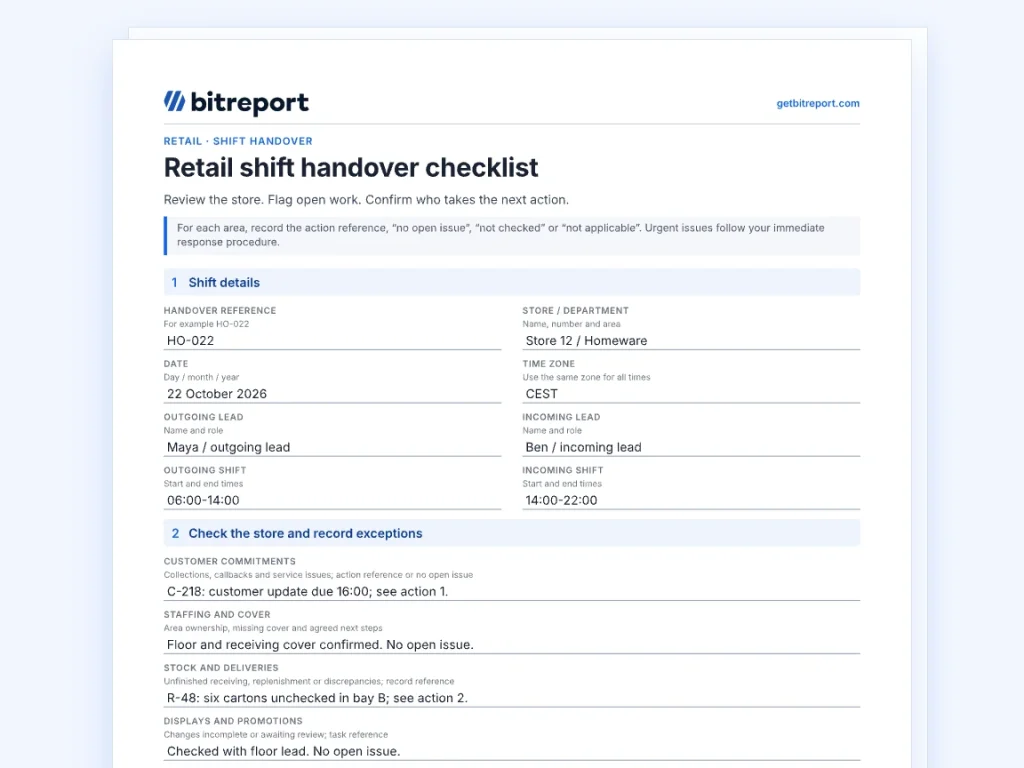
A retail shift handover checklist helps the outgoing and incoming teams review what is unfinished, what has changed and who will act next. A useful handover leaves each open issue with a current status, a named owner and a deadline for the next action.
Imagine a customer was promised an update on a collection order by 4:00 PM. The colleague who made that promise finishes at 2:00 PM. “Check collections” in a chat message does not tell the afternoon team which order needs attention, what has already been checked or when to call. The handover should preserve that commitment.
Use the template below to make the change of shift part of your retail operations routine. It works for a midday changeover or the closing team’s handover to the next morning.
Download the retail shift handover template

Use the first page to review the store’s condition and flag what needs attention. Use the second for open actions and confirmation by the incoming lead. The form can be filled on a computer or printed; adapt its prompts to your store’s procedures.
Keep the handover with the shift’s records. Reference existing tasks, order records and incident reports rather than copying their entire history. If more actions are open than fit on the form, attach another action page with the same handover reference. Check that all entered text is visible before printing.
What to check before handing over a retail shift
Review the areas that could change what the next team needs to do. Record an exception when there is something to act on; use “no open issue” only after checking. “Not checked” is a different status and needs a follow-up owner when the check matters to the next shift.
| Area | Question for the handover |
|---|---|
| Customer commitments | Which collections, callbacks or unresolved service issues have a promised next step? |
| Staffing and cover | Who is taking over each area, and what cover still needs confirming? |
| Stock and deliveries | What is waiting for receipt, checking, replenishment or a decision? |
| Displays and promotions | Which change is incomplete, or waiting for review? |
| Equipment and store condition | What is unavailable, restricted or waiting for repair? |
| Cash, keys and security | Which transfers or exceptions need confirmation under the store’s procedure? |
The downloadable checklist includes space to record the result and link open items to their next action. These prompts are a handover review, not a replacement for your cash-count, opening, closing, food-safety or incident procedures. Keep sensitive customer details, security codes and cash information in the designated records.
For example, “delivery received” may mean only that the driver has left. If six cartons remain unchecked, the incoming lead needs to know their location, the receiving reference and who will finish the check. That is the difference between an update and a usable handover.
Run the handover in three stages
The HSE’s shift-handover guidance describes preparation, exchange of relevant information and cross-checking by incoming staff. It also recommends two-way discussion supported by written information. Those communication principles are useful for store handovers; the retail examples here are our practical adaptation, not an HSE retail checklist.
Prepare the open work before the changeover
Update the original task or record before the handover conversation. Mark finished work accurately, note what remains and identify any new constraint. A task waiting for a delivery, approval or contractor should say what it is waiting for and when someone will check again.
Highlight the items with consequences during the next shift: a customer promise, a deadline, missing cover or an unavailable fixture. Leave routine completed work in the normal checklist unless the incoming team needs the outcome to avoid repeating it.
Discuss priorities and check the actual situation
The outgoing lead explains the current position; the incoming lead asks questions and checks anything unclear. Walk to the relevant area when seeing it will resolve uncertainty, such as an unfinished display or a delivery waiting in the stockroom.
Plan enough time within the shift for this exchange. A fixed five-minute target may work on a quiet day and fail when several departments have open issues. Let the amount and importance of unfinished work determine the discussion, while keeping the written notes concise.
Confirm who takes the next action
The incoming lead confirms the next owner and due time for each priority. If the work belongs to a manager or maintenance team, say who owns the work and who in the store will check for an update. Do not assign a repair to the incoming cashier simply because they received the handover.
Record unresolved questions and the person who will settle them. Acknowledging the handover does not mean the work is complete. Keep the linked task open until the required action and any review have happened. This is the practical follow-through behind effective retail frontline communication.
A filled retail shift-handover example
Here is an illustrative changeover in a homeware store. Maya is handing over to Ben at 2:00 PM on October 22. The team has three open items; the people, references and times are invented to show how the record works.
Ben confirms the priorities at 2:05 PM and records that he has taken over the store follow-up. The collection, receiving and support records remain open. There is no contradiction: the handover is acknowledged, while the underlying work is still being done.
Write notes that tell the next person what to do
A useful note combines current position and next action. “Printer broken” describes a problem but leaves the next shift to rediscover the asset, support contact and expected update. “P-02 unavailable; IT-092 open; duty manager owns support follow-up; Ben checks at 2:30 PM” makes the next step clear.
Use a reference the next person can actually access. A task link, order ID or fixture number is usually more useful than a long account copied from a private conversation. Include a photo where visible condition matters, such as a display awaiting review, but do not treat a photo as proof of an action it cannot show.
Separate a completion deadline from a check-in time. In the example, 3:30 PM is the planned receiving-check deadline. The printer’s 2:30 PM time is only a support update; it does not mean that the printer will be repaired then.
Keep unexpected safety issues on the retailer’s immediate response route. Reporting a hazard in the handover is not a reason to leave it unattended until the next shift. Use a separate retail incident report when an event requires its own factual account, evidence and investigation.
What if the shifts do not overlap?
The outgoing lead leaves a current written handover and follows the store’s agreed route for anything that needs attention before the next team arrives. Record the manager or contact responsible during the gap; an unread note is not confirmation that someone has accepted an urgent issue.
At the next shift’s start, the incoming lead reviews the record, checks the situation and confirms receipt. Questions go to the designated contact through the agreed work channel. Arrange a scheduled conversation where the complexity of the handover requires one, rather than relying on off-duty colleagues to notice messages.
For a closing-to-opening handover, identify what the opening team must verify before trading. Shopify’s retail opening and closing guide includes leaving a status update or handover log for the morning crew. Keep that update focused on exceptions and unfinished work; the opening checklist still covers the normal opening routine.
Keep the handover connected to store tasks
The checklist gives the incoming team an overview. The task record holds the instructions, due date, evidence and progress of each piece of work. When those records are separate, link them with the same reference and decide which record holds the current status.
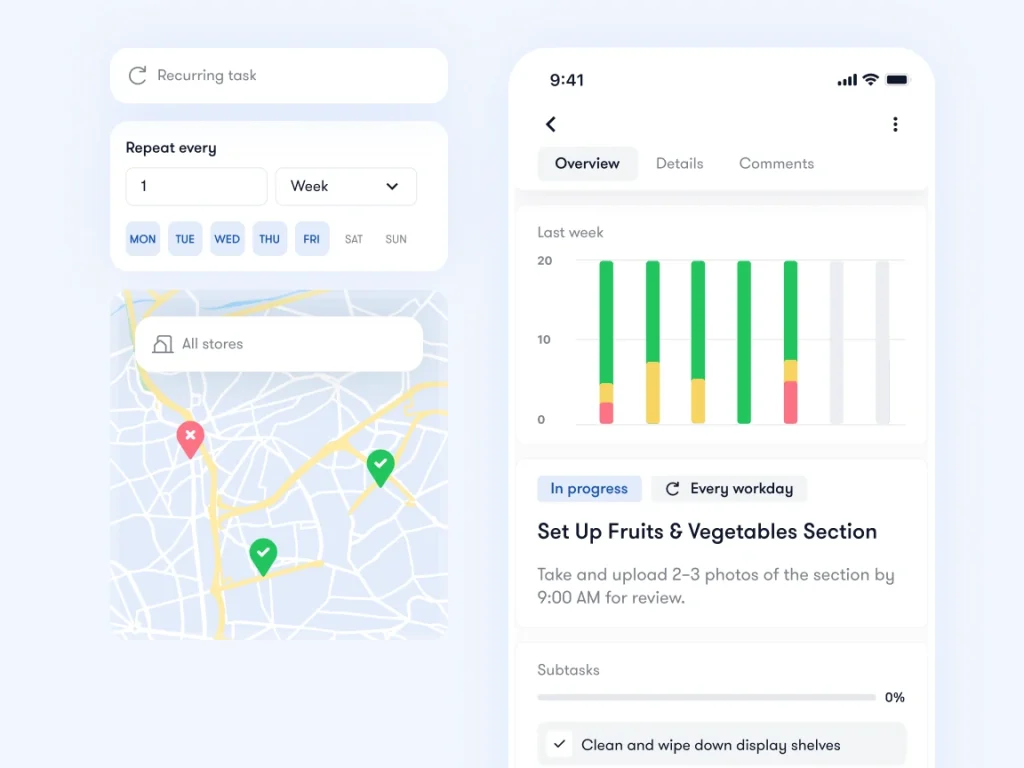
Bitreport task management supports assigned store tasks with instructions, deadlines and progress tracking. Use those task records to preserve the work across shifts, while the handover identifies what the incoming team needs to review. The product view below shows recurring task settings beside the instructions and progress on a mobile store task.
A store manager reviewing handovers should look for recurring gaps: items passed between shifts without an owner, repeated missed updates or work marked complete before review. Use those findings to improve the retail store workflow and staffing arrangements, rather than adding more fields to every handover.
Frequently asked questions
Is a shift handover checklist the same as a closing checklist?
No. A closing checklist covers the tasks needed to close the store. A shift handover transfers relevant information and unfinished work to the incoming team. A store may need a handover during trading as well as after closing.
Who should complete the retail shift handover?
The outgoing lead prepares the record, with input from the people responsible for open work. The incoming lead reviews it, clarifies priorities and confirms the next owners. Department leads can contribute their own updates where the store is larger.
How long should a retail shift handover take?
Allow enough scheduled time to discuss the open work and check anything unclear. A routine changeover can be brief; missing cover, maintenance restrictions or several customer commitments need more attention. Avoid a universal time limit that cuts off important questions.
Does accepting the handover close the tasks on it?
No. It confirms that the incoming lead has reviewed the handover and understood the next steps. Each task keeps its own status and remains open until the work and any required verification are complete.