
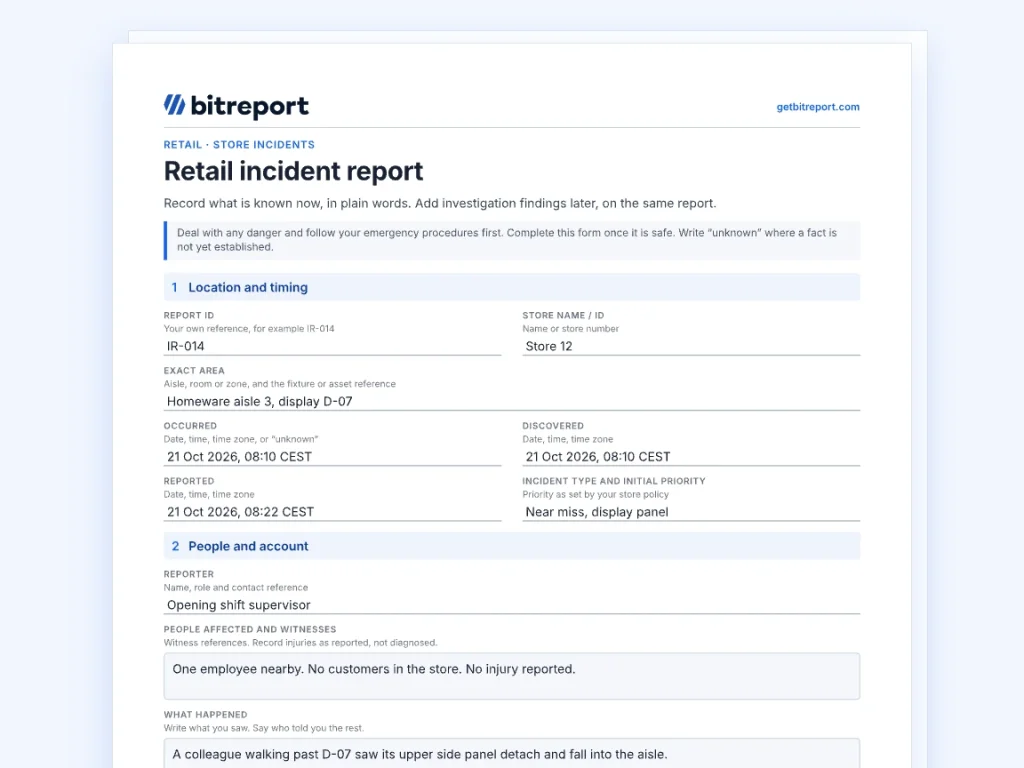
A retail incident report records what happened in a store, where and when it happened, who was involved, what the team did immediately and who owns the follow-up. It gives the next manager a reliable account without relying on a shift handover or a message buried in chat.
Use the retail incident report template below for an initial internal record of an injury, near miss, damaged fixture, equipment failure or other store incident covered by your reporting procedure. Record the facts available now; add investigation findings when they are established.
Respond to immediate danger and follow your emergency procedures before completing paperwork. This internal form does not replace required external reports, insurance forms or jurisdiction-specific injury records. Your responsible manager should check those requirements promptly; for example, OSHA has separate recording and reporting requirements in the US.
Download the retail incident report form

The two-page form can be completed on a computer or printed. Page one captures the incident and immediate response. Page two records evidence, notifications, follow-up and the manager’s review. Use the same report ID on both pages and save the completed copy in your approved, access-controlled location. Attach a continuation page with that ID if an account will not fit; check that all entered text is visible before printing.
Here is the structure to copy into your own form or reporting system:
| Field group | What to record |
|---|---|
| Report reference | Report ID, store name or ID, exact area and fixture or asset reference |
| Dates and times | When the event occurred, when it was discovered and when it was reported; include the time zone |
| Reporter and people | Reporter, role and contact reference; people affected and witness references |
| Event and impact | Incident type, factual sequence, observed damage and injuries reported |
| Immediate response | Actions taken, by whom and when; remaining hazards or restrictions |
| Evidence and notifications | Photo or record references; people notified, time and instructions received |
| Follow-up and review | Owner, next action, due date, findings, linked corrective actions, verification and closure decision |
Write “unknown” where a fact is not yet established, and “not applicable” where a field does not apply. An empty field makes it harder for the next person to tell whether the detail was checked.
What should count as a retail incident?
Use your store’s reporting policy to define the events that need a record and the route for urgent escalation. Common examples include a customer fall, an employee injury, a display collapsing, damage to equipment or a security event. Sensitive security and personal information may need a restricted reporting route rather than a general store task.
A near miss is an event in which someone could have been harmed, even though no injury occurred. A shelf panel falling next to an employee is a near miss; noticing a loose panel before it falls is a hazard observation. Both may need action, but the record should describe what actually occurred.
OSHA’s incident investigation guidance encourages investigating worker injuries and close calls, with attention to underlying causes rather than blame. A lack of injury is therefore not a reason to discard a useful record of an event.
Filled example: a display panel falls before opening
This illustrative example shows an initial report. It is not a customer incident or a completed investigation.
Notice what the example leaves out: it does not claim that poor installation caused the panel to fall, diagnose an injury or mark the incident resolved because a repair was requested. Those would be unsupported conclusions at this stage.
How to write an incident report that another manager can use
Separate what you saw from what someone told you
Write a short sequence using specific places, actions and times. “The panel was on the floor beside display D-07 when I arrived at 8:12 AM” tells a reviewer more than “the display was unsafe.” Attribute a witness account to its source instead of presenting it as your own observation.
Avoid guesses about fault, motive or medical conditions. Record an injury as reported and route it through your established procedure. If a detail changes later, add a dated correction explaining the new information rather than silently replacing the original account.
Describe the response and anything still unresolved
Record who took each immediate action and when. Include any ongoing access restriction, unavailable equipment, affected store activity and person who must authorize the next step. “Manager informed” is incomplete if the next shift cannot see which manager, at what time or what they instructed.
A report should not make a store wait for administrative approval before following its emergency response procedures. Record urgent actions afterwards when it is safe to do so.
Reference evidence without spreading sensitive details
Give each attachment a clear reference, such as P-01 for a photo or W-01 for a witness account. Describe what it shows and when it was captured. A photo can document visible damage; it does not establish why a fixture failed.
Use approved storage and access rules for personal information, witness details and relevant CCTV references. Collect what the investigation needs without copying sensitive information into a widely visible task. Follow your organization’s retention and evidence-preservation procedure; do not assume that keeping a link to footage preserves the recording itself.
Give the follow-up an owner and a review point
Assign a named owner for the incident record and separate owners for any repair or corrective actions. Record when the next update is due, even if the final resolution date is not yet known. That makes the open work visible during shift changes and regional reviews.
For multi-location teams, use the same core fields across stores while allowing local reporting requirements. That consistency helps retail operations managers compare recurring issues without losing the detail of an individual event.
Incident report, investigation and corrective action: keep them connected
The initial report answers “what do we know happened?” The investigation examines why it happened. Corrective actions address causes or weaknesses identified by that investigation. They can be connected records; they should not be treated as interchangeable stages.
The HSE investigation workbook separates gathering information, analysing it, identifying controls and implementing an action plan. Use that distinction when adding later findings to the report.
In the display example, maintenance might confirm a damaged mounting component. That finding could lead to a repair and a review of similar fixtures. It should not be written into the initial account before it is known. Use a linked corrective action report when follow-up needs its own cause, owner, deadline and effectiveness check.
Before closing the incident record, the reviewing manager should confirm the disposition of the affected area or equipment, check the evidence for completed actions and record any longer-term work that remains open with a named owner. A closed repair ticket is not, by itself, proof that every consequence of the incident has been addressed.
Move from reporting to assigned store follow-up
A PDF is useful for a consistent record, but it does not notify the next owner or keep a repair moving. Decide where the record lives, who receives it and how the next shift sees unresolved work.
For operational issues, Bitreport incident reporting lets store teams report issues with photos, notes and a location, then follow assigned work through to resolution. The existing product view below shows operational repair requests and their statuses, rather than an injury record or a statutory reporting form.

Keep your internal incident reference connected to the relevant task or repair so a reviewer can find both the original facts and the later action. Use the retailer’s designated system and restricted process for injury, security or other sensitive records.
Frequently asked questions
What should a retail incident report include?
Include the store and exact location, occurrence and reporting times, reporter, factual account, people affected, immediate actions, evidence references, notifications and follow-up owner. Add investigation findings and a dated review as they become available.
Should I report a near miss if nobody was injured?
Follow your store’s reporting procedure for near misses. Record the event and the potential for harm even when nobody was injured. Distinguish a near miss that occurred from a hazard noticed before an event happened.
Can I complete the report before I know the cause?
Yes. Record the known facts and mark the cause as not yet established. The initial report preserves information for the investigation; it does not need to guess the investigation’s conclusion. Add dated findings later.
Does this template replace an OSHA or other official report?
No. This is an internal operational record. Your responsible manager must separately check which injury records, external notifications or other reports apply to the incident and location. Completing this form does not complete those obligations.