

It is 9:40 AM on a Saturday. The fitting rooms need a reset, a price change lands at noon, the delivery driver is at the back door, and head office has just sent a “quick” display update marked urgent. Retail task prioritization is how the store manager decides what actually happens first, what waits, and who owns that call when the day cannot hold everything.
The short version: handle anything that affects customers or safety now. Protect work with a real deadline. Then fill the hours you genuinely have with the most important work that is ready to start. Everything else gets a named owner and a new time, not a shrug.
A list that labels tasks “high”, “medium” and “low” does not do this. Labels do not create capacity, and they do not help when two “high” tasks need the same person at the same time. This guide shows a way to choose that a manager can also explain to head office, as part of a wider retail operations routine.
How to prioritize retail tasks: start with what cannot move
Ask one question first: what happens if this waits, and when does that start to matter? The answer usually puts the task in one of four groups.
It cannot wait. Something is affecting customers, staff or the store right now: a spill, a failed till, a queue with nobody free to serve. Follow the store’s response procedure. This is not a scheduling decision.
It has a real deadline. A promotion goes live at a set time, a price change takes effect, a delivery window closes. Work backwards from the deadline and reserve the people before the day fills up.
It keeps the shift running. Replenishment, fitting-room resets, breaks, handovers. This work has no single deadline, but the store feels it within the hour if it slips. Sequence it around the peaks.
It is flexible. The stockroom reorganization, the fixture repair that is annoying but safe, the display improvement with no date attached. Flexible work still deserves a slot. It just does not get to jump the queue because someone typed “urgent” in a subject line.
Shopify’s guide to retail prioritization makes a similar point with deadlines, time commitment, business impact and customer value. You do not need a scoring model. You need to know which group a task is in, and to be honest when a preference is dressed up as a deadline.
Once the immediate problem is handled, say out loud which planned work it displaced. Otherwise the displaced task quietly becomes tomorrow’s emergency.
Put every request on one task list
Priorities fall apart when work lives in five places: the group chat, an email thread, a note from the last shift, a head-office portal and the manager’s memory. Bring it into one list: recurring routines, head-office assignments, problems found on the floor and anything unfinished from yesterday. One request copied into three channels is still one task.
For every task on that list, the manager should be able to answer five questions:
What result is required, and why does it matter today?
Who owns it, and which skills or access does it require?
When must it be finished, and is that deadline fixed or negotiable?
How much working time is likely to be needed?
What materials, approval or earlier task must be ready first?
Keep priority and readiness apart. A display change can be the most important job of the week and still not be startable, because the approved artwork has not arrived. Sending it to the floor again every morning does not make it ready. Give the missing artwork its own task, its own owner and a time to chase it.
And treat “overdue” as a question, not a verdict. A task can be overdue because it was genuinely blocked, because the estimate was fantasy, or because three busier days pushed it out. Find out which before you let it jump ahead of today’s customers.
Check the hours you actually have
Now do the arithmetic nobody enjoys. How many person-minutes does this shift really have for task work, after tills are covered, breaks are taken and someone senior stays free for approvals and problems?
Say two associates each have 30 minutes away from customer-facing work this afternoon. That is 60 person-minutes, not an hour each to play with. A display reset that needs two people together for 30 minutes spends all of it. The replenishment job does not also fit because the clock showed 30 minutes.
Estimates only need to be honest, not precise. “About 20 minutes, one person” is enough to spot a collision on paper instead of at 4:30 PM. Do not turn estimates into a league table for individuals: the moment people fear the numbers, the numbers become fiction.
When the work does not fit, something has to give: a smaller scope, a moved deadline, an extra pair of hands, or a decision from whoever sent the work. What cannot give is the break, the safety check or the customer on the floor. If a mandated check or a campaign requirement needs to change, that call belongs to the person authorized to make it.

Decide what moves, and write it down
With the immovable work covered, compare what is left by one measure: what does another day of delay cost? Work that unblocks something bigger goes early. A quick job that unblocks nobody can wait, even if it would feel good to tick it off.
Two tasks with the same cost of delay? Do the one that is ready, or the one that shares a location, a ladder or a skill with work already under way. And do not start five jobs at once to look busy. Three finished tasks beat seven half-finished ones, every shift.
Every deferred task leaves the conversation with an owner and a new time. “We will get to it” is where tasks go to be forgotten. Write down what moved, why, and who agreed. If the deadline is not yours to move, the request goes up before the deadline passes, not after.
Make that request easy to answer: “We can finish the launch setup by 4:00 PM or clear the stockroom backlog, not both. The launch starts tomorrow morning. Can the backlog move to Tuesday afternoon?” One sentence of context, one clear choice. That gets a decision. “We are very busy” does not.
A busy Monday afternoon, step by step
An invented example, with invented people. On Monday, Oct 26, 2026, a home-and-lifestyle store has a display change due before tomorrow’s opening, a stockroom reset with no deadline, and an open question about the display artwork. The afternoon team is also covering the floor.

2:00 PM EDT. Sam, the manager, looks at the list. The display change has the only real deadline, but it cannot start: the artwork is not approved. Instead of sending staff to “make a start”, Sam gives the artwork question to the campaign owner with a 2:30 PM checkpoint. The team covers the floor and the routine work.
2:30 PM EDT. The artwork lands. Sam puts Leah and Omar on the display from 3:00 PM to 3:30 PM and keeps a third person on the floor. The stockroom reset moves to tomorrow afternoon, with Omar as owner. A deferral with a name and a time, not a disappearance.
2:50 PM EDT. The store gets busy and Omar is needed at the till. Sam does not let the display start short-handed and hope. The window moves, the area manager gets the choice between cover from a nearby store or a setup before opening, and the change is recorded against the task.
The plan “failed” and the prioritization worked. Everyone can see what the deadline needs, who is deciding, and what happens next. That is a better outcome than a green list nobody believes.
When head office sends three top priorities at once
Stores should not have to referee between marketing, merchandising, operations and training when their deadlines land on the same Tuesday. Someone has to own the collision: usually an operations lead, working through area managers, who can look at everything heading for a store and sequence it.
Zipline’s analysis of the head-office/store disconnect describes exactly this pile-up of competing initiatives against limited store hours. The fix is not a better attitude in stores. It is fewer, clearer requests: what outcome, which locations, what deadline, roughly how long it takes, and what needs to be ready first.
Target the work, too. If one store format has the fixture, one format gets the setup task. Sending it to all 40 locations “just in case” creates 39 stores asking what they are supposed to do, and a manager in each one spending the time you were trying to save.
And when something urgent genuinely appears mid-week, the message should say what it replaces or what help comes with it. “Everything is top priority” is not a priority. It is the decision being handed to the store without the authority or the information to make it.
Keep the decision where the next shift can find it. Our retail frontline communication guide covers how instructions, questions and answers stay attached to the work instead of dissolving into chat.
Make the plan visible in the shift briefing
The briefing at the start of a shift needs four things, and they fit on one screen or one sheet: what must finish this shift, the first job for each person, what is blocked and waiting on a decision, and who is allowed to change the plan when the day moves.
Check in at moments that mean something: the delivery arrives, the artwork lands, the queue builds. Not a status meeting for every routine task. At handover, pass on the unfinished work with its status and next step; the retail shift handover checklist is built for exactly that transfer.
Bitreport’s task management tools keep instructions, owners, deadlines, photos and comments on one record for each task, so a manager can see completion across locations and chase what is late. The software holds the plan still. It does not make the call: when the day fills up, a person still decides what moves, and the record shows who decided and why.
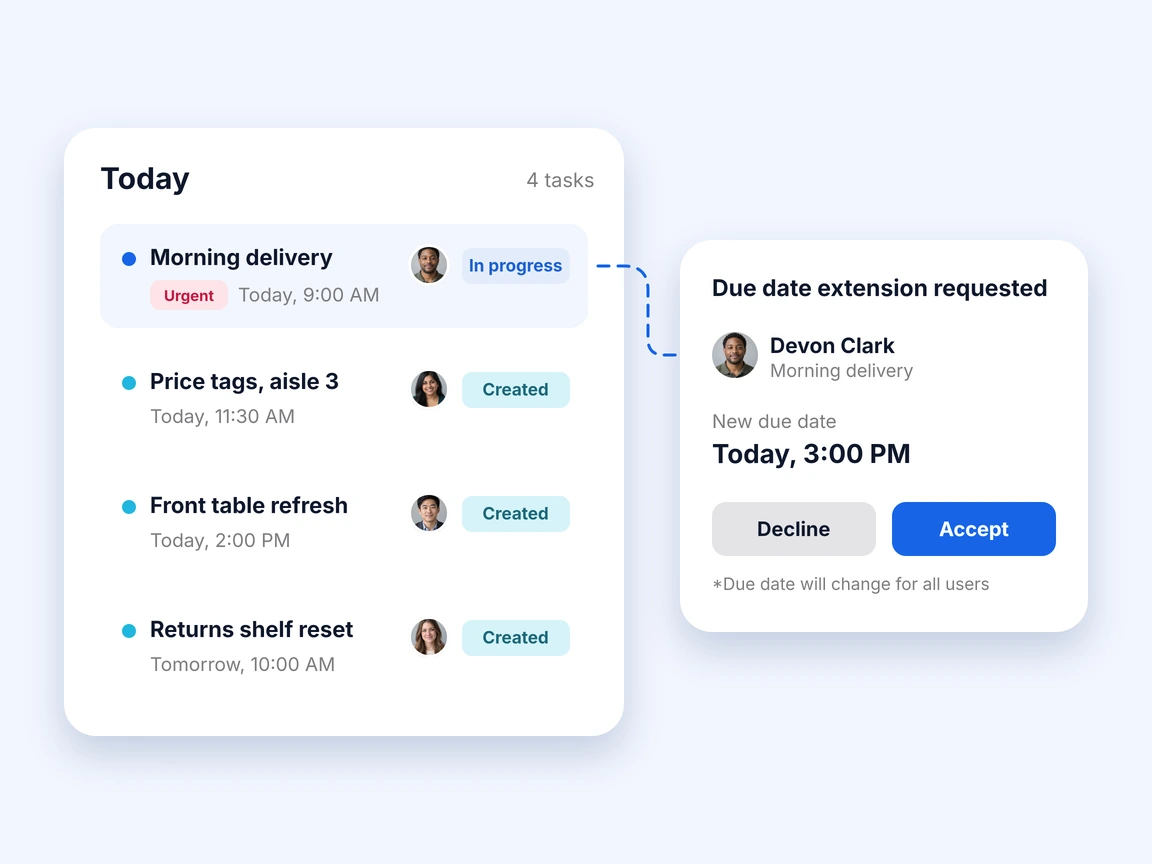
When evaluating retail task management software, test a real conflict rather than only a clean task assignment. Can the store explain a blocker, find the current instruction and see the revised owner or deadline? Can the area manager understand what remains open without rebuilding the conversation from chat messages?
Review what you moved, not just what you ticked
A completion count flatters everyone. A store can tick off eleven easy tasks, miss the one deadline that mattered, and still look productive in the report. Review the decisions instead: which fixed-deadline work finished on time, which missed, and how often the same work keeps moving.
Keep the original deadline next to the agreed one. A task deferred four times is not four small delays; it is one decision nobody wants to make. Either reserve the time, cut the scope, or stop asking for it.
Look at the causes, too. Stores waiting on artwork every launch means the brief process is late, not the stores. Work displaced by the same Saturday peak every week means the plan should not have put it on Saturday. Estimates that are always half the real time should be doubled before the next assignment goes out, not after the next miss.
Start in one store, or a handful, where the operations team can read a real week of these decisions up close. A month of honest numbers from five stores teaches more than a chain-wide rule written in a meeting. To explore how to keep assignments, evidence and follow-up together, book a Bitreport demo with a recent example of competing priorities from one of your stores.
Frequently asked questions
What is the difference between an urgent and an important retail task?
Urgency describes how soon a response is needed. Importance describes the consequence for customers, people or store operations. A planned launch can be important before it becomes urgent. A request marked urgent still needs a clear reason and deadline so the manager can judge what should happen next.
How do you decide what goes on a store’s task list for the day?
Four things: what must finish in this shift, the first job for each person, anything blocked and waiting on a decision, and unfinished work handed over from the last shift with its next step. If an item has no owner and no deadline, it is a wish, not a task, and it should not crowd out work that has both.
Who should decide when two head-office tasks conflict?
The retailer should name an operations or regional decision owner who can reconcile the requests with the teams that issued them. The store manager supplies the capacity, timing and local constraints. A revised deadline or scope should be agreed by someone with authority to change it, then recorded with the task.
Should stores always finish the quickest tasks first?
No. Effort is useful when comparing work with similar impact and deadlines. It should not move an easy, flexible task ahead of an important commitment or required response. Use short jobs to fill suitable gaps only after checking what the store must deliver and what those jobs might interrupt.