

Every store that receives, stocks and sells physical goods will see damage. Finding it is the easy part. What goes wrong is what happens next: a cracked carton is pushed behind the backstock, three broken jars wait in the stockroom for “someone”, and a month later nobody can say where they came from, whether the supplier would have paid or whether other stores had the same problem. A retail damaged goods procedure is the routine that stops this.
It takes a damaged item from the moment someone finds it to a recorded outcome: isolated, documented, decided, adjusted in the stock system and closed with proof. This guide covers damage that arrives with deliveries and transfers, damage that happens in the store and damage caused by customers.
The store team does the physical work and the follow-up. Stock quantities stay in your inventory system, and the rules for food, medicine, recalls and accounting stay with the people who own them. For the wider picture, see our guide to retail operations.
Where damaged goods come from
The first minutes are the same for every case. The source decides who else needs to know and which evidence they will ask for.
Damage found at the door belongs to the receiving routine first. Our retail goods receiving checklist covers the checks at delivery, and our retail stock transfer process covers goods moving between stores. This guide starts when the damaged goods are in your hands and need an owner.
The retail damaged goods procedure in five steps
Five steps, one owner per step and one case reference from start to finish. The reference can be as simple as the store code, the date and a running number, for example S12-1102-03 for store 12, Nov 2, third case. Write it on the hold tag first. Every photo, note and stock entry that follows carries the same reference.
1. Stop the sale and isolate the goods
Take the goods off the shelf, off the pick list and out of sellable backstock the moment they are found. A damaged item that stays where it was can still be sold, picked for a transfer or counted as usable stock.
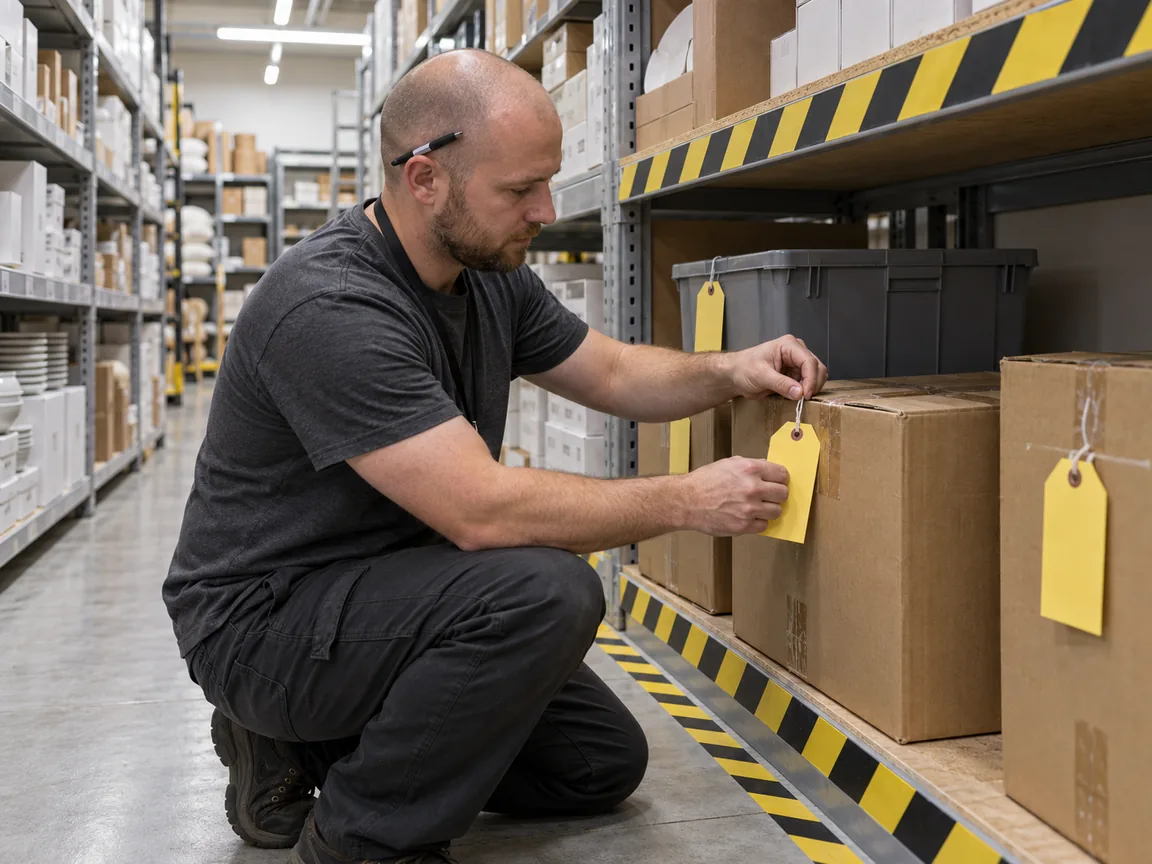
If it is safe, take one photo where the goods were found. Then move everything from that case to one marked hold area: a labeled shelf, bin or cart away from the sales floor and from sellable backstock. Tie a hold tag to each carton or bin with the date, the case reference and the name of whoever found it. For where a hold area fits in the room, see our retail stockroom organization guide.
Keep the goods of one case together, and do not repack or clean them yet. If the damage is a hazard, such as broken glass or a leaking product, handle it under your site’s safety procedure first and photograph what remains.
2. Record the case while the goods are in front of you
Open one case record for each find, using the reference from the hold tag. The person who found the damage fills it in, because nobody else can reconstruct it later. The record needs four things:
When and where the damage was found, and by whom
What the goods are: product, variant or size, lot or serial number if printed, and the number of units
Where they came from: supplier delivery, store transfer, store handling, customer or unknown, with the delivery or transfer reference if there is one
What probably caused the damage, marked as a suspicion unless you are sure
Write what you can see, not what you assume. “Three jars broken, lids intact, carton wet on one side” helps a supplier or a manager. “Bad delivery” does not.
Take the same photos every time: the outer packaging, the damaged item and how it was packed inside, a close-up of the label or barcode, and the hold area. UPS, for example, asks for three photos when a damage claim needs them: the damaged item and how it was packed inside the box, a close-up of the shipping label with the tracking number, and the outside of the package.
Delivery damage has a clock. Carriers set their own claim windows: UPS asks you to start a claim within 60 days of the scheduled delivery, and FedEx Freight asks for concealed damage to be reported within 15 days of delivery. Other carriers, services and countries differ, so check your agreement, write down the delivery date and report the same day you find the damage. Keep the packaging, too. UPS tells you to hold on to the contents and the packaging, and a carrier may want to inspect them.
3. Decide what happens to the goods
One named person decides, by an agreed time. In most stores that is the store manager up to a value limit you set, and the area manager above it. Without a deadline, cases drift: pick a time your team can keep, such as the end of the next shift, and name who covers when the decision-maker is away.
The options depend on the product, your company policy and local rules. The table shows the usual ones and the proof to keep for each.
| Outcome | When it fits and what to keep |
|---|---|
| Return to supplier | The supplier agrees to take the goods back or issue a credit. Keep the return number, a photo of the sealed carton and the credit note. |
| Repack and sell | Only the outer packaging is damaged, and the product inside is intact and complete. Keep before and after photos and the name of whoever checked the contents. |
| Sell at a reduced price | Your policy allows it, and the product is safe, complete and clearly marked as damaged or open box. Keep the approval, the new price and a photo of the marked item. |
| Donate | The goods are safe to use, your policy allows donations and the receiver accepts them. Keep the receiver’s receipt or confirmation. |
| Dispose | Nothing else is allowed or possible. Keep photos of the goods before disposal and the approver’s name, and follow local disposal rules for glass, batteries, aerosols and electronics. |
Food, medicine, cosmetics, baby products, batteries and recalled goods follow their own rules, so send those cases to the person who owns the rule instead of choosing from the table. A carrier claim can run alongside a return or disposal. Keep the packaging and the photos until the claim is settled.
4. Keep the stock record honest
The hold area is the physical step. The stock record needs its own, or the shelf and the system will disagree about what you can sell.
Record the damage in your inventory system as soon as the goods are isolated, and update it when the outcome is final. Many systems keep a separate status for damaged stock. In Shopify, for example, units can move from available to an unavailable Damaged state, where they stay on hand but cannot be sold, and are removed later. Square lets you choose a Damage reason when you adjust stock. Labels differ by system, so follow the steps of your own.
Use the damage reason, not a general count correction. Damage is one cause of inventory shrink, next to theft and counting errors. A damaged unit logged as a correction disappears into count differences, and the pattern is lost. Shopify lists Damaged and Count as separate reasons, and both Shopify and Square keep an adjustment history, so the entry can be checked later. Our guide to reducing retail shrinkage shows how to calculate the shrink rate and where the rest of it comes from.
Add the case reference to the note field if your system has one. Whoever reads the history later can then find the photos and the decision. For how stock records are kept in the first place, see our retail inventory system guide.
5. Close the case with proof
A case is closed when the goods have left the hold area and you can show where they went. Before you close it, check three things: the stock record shows the final outcome, the proof from the table is attached to the case, and the hold tag is gone. Then write the date and the name of the person who approved the outcome.
Chase the money. A return that has shipped but never been credited is still an open case, and so is a carrier claim with no decision. Put the credit date or claim reference on the record and check it in the weekly review below. Our guide to the retail return to vendor process covers the deadlines vendors set, the authorization number and how to check the credit note.

Example: cracked tumblers found four days after delivery
This is an invented example to show the sequence, not typical results. A store receives a case of 12 boxed glass tumblers on Thursday, Oct 29, 2026. The carton looks fine and the count is right, so the delivery is signed off.
On Monday, Nov 2, at 4:00 PM, a stocker opens the case in the backroom and finds four tumblers cracked. She stops, photographs the carton, the cracked tumblers, the packing inside and the shipping label, and moves the case to the hold area with a tag that shows the date, “delivery Oct 29” and her name. Her record says four cracked, eight checked one by one and undamaged, delivery reference noted, suspected cause: transit.
The store manager decides before the end of the next shift: report the damage to the supplier and the carrier, keep the carton and put the eight good tumblers back on the shelf. The delivery was four days ago, inside both windows quoted earlier, so the claim goes out the same day. The four tumblers leave sellable stock with the damage reason and the case reference in the note.
When the supplier approves a credit, the damaged tumblers are packed, photographed with the return label and sent back. The case stays open until the credit note arrives 12 days later. Only then does the stocker take the tag down and the manager close the record.
Review open cases every week
Once a week, spend ten minutes on the list of open cases. Look for three things: goods that have been on hold longest, supplier claims without a credit, and causes that repeat. Repeated damage is a process problem: the same supplier, the same product, the same shelf or the same delivery day.
Two numbers help once you have a few weeks of cases. The first shows how much of what a supplier delivers arrives damaged:
Supplier damage rate = (damaged units from that supplier ÷ units received from that supplier) × 100
The second shows whether claims turn into money back:
Claim recovery rate = (credit received ÷ value claimed) × 100
Use both to compare suppliers, products and stores with each other, not as targets to hit. A store that logs every case will show a higher damage rate than a store that hides some, and that is the store to learn from. When a cause repeats, change the cause: move fragile products off high shelves, ask the supplier to change the packing, or unload pallets differently.
Make the procedure visible across stores
A procedure on paper depends on memory. In a multi-store chain, the practical questions are whether every store opens, works and closes cases the same way, and whether anyone above store level can see which ones are stuck.
Bitreport task management can give every case an owner, a due date and required photo proof, and a reviewer can mark up a photo and send it back with a note until it shows what is needed. A repeating task can run the weekly hold-area review in every store. On store visits, an audit item can check that damaged goods are tagged and kept apart, and a failed item creates a corrective task with a deadline.
Bitreport does not post stock adjustments or replace your inventory system, so put the case reference in the task and make the stock entry where you keep stock. To see how assigned work and photo proof look across locations, book a Bitreport demo.
Frequently asked questions
Who decides what happens to damaged goods in a store?
One named person decides, by an agreed time. In most stores that is the store manager up to a value limit you set, and the area manager above it. Without a deadline, cases drift: pick a time your team can keep, such as the end of the next shift, and name who covers when the decision-maker is away.
What photos should you take of damaged goods?
Take the same photos every time: the outer packaging, the damaged item and how it was packed inside, a close-up of the label or barcode, and the hold area. UPS, for example, asks for three photos when a damage claim needs them: the damaged item and how it was packed inside the box, a close-up of the shipping label with the tracking number, and the outside of the package.
How soon must damage found after a delivery be reported?
Carriers set their own claim windows: UPS asks you to start a claim within 60 days of the scheduled delivery, and FedEx Freight asks for concealed damage to be reported within 15 days of delivery. Other carriers, services and countries differ, so check your agreement, write down the delivery date and report the same day you find the damage.
Should damaged stock be logged as a count correction?
Use the damage reason, not a general count correction. A damaged unit logged as a correction disappears into count differences, and the pattern is lost. Shopify lists Damaged and Count as separate reasons, and both Shopify and Square keep an adjustment history, so the entry can be checked later.