
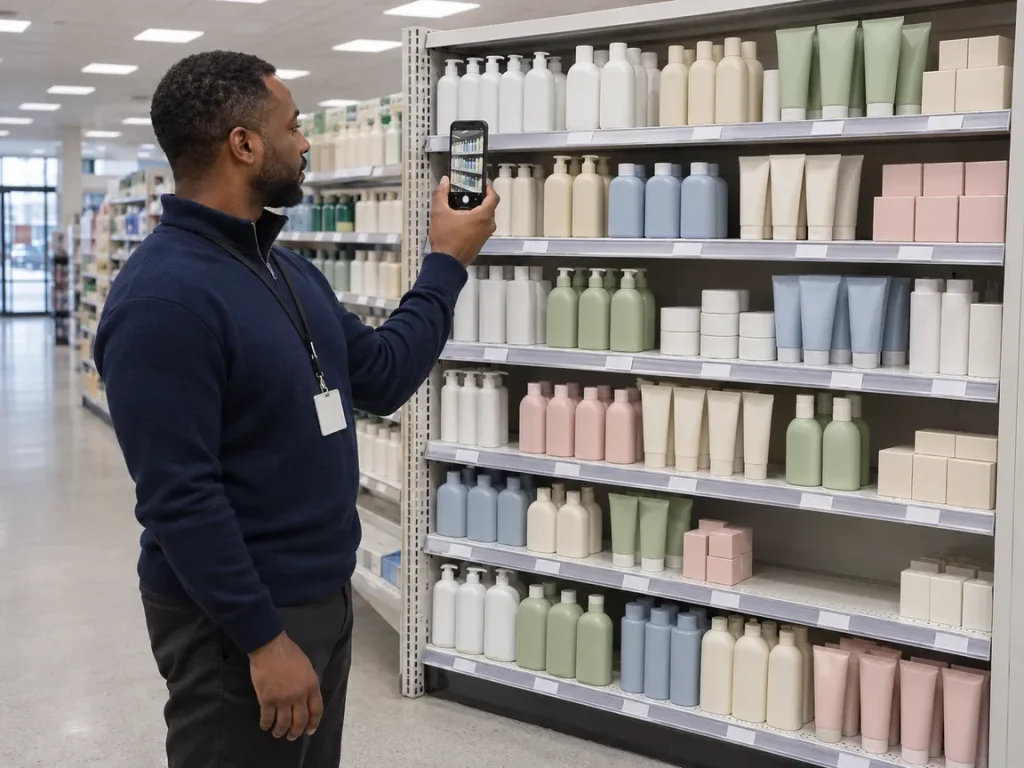
A merchandising audit is a store check of shelf, display and tags against the plan that head office set. The plan is the planogram, the price file and the promotion brief. Every check answers one of three shopper questions. Is the product where the plan says? Does it cost what the tag says? Is it there to buy? Some teams call the same check a merchandise audit.
This guide is for the people who read the results and act on them. That means area managers, category and merchandising teams and operations leads in grocery, drugstore and similar stores. It covers the five areas an audit looks at and three moments to run one. You also get a fixed store walk, how to read results across stores and who fixes each miss. Brands and field agencies run their own version for their own products. This one is written for the retailer, where the audit covers the whole fixture.
A merchandising audit is one slice of a full store audit, which also covers safety, cleanliness and service. It covers only what the shopper meets on the shelf and the display: placement, price, promotion, availability and condition. Our retail audit guide shows where it sits among the other types. Fashion stores can start with our visual merchandising audit checklist. It runs the same check against a visual merchandising (VM) brief.
What a merchandising audit checks
Five areas cover the three shopper questions. Every check on your list belongs to one of them, and every check leads to an action when it fails. Each area has its own deep dive. Read grocery planogram compliance for placement and the retail price audit for price. Use promotion execution in retail for promotions and retail out-of-stocks for availability. The merchandising audit is the visit that checks all five together.
Keep the list short enough to finish
A check that never leads to an action does not belong on the list. A check that asks two things at once, such as displayed and priced correctly, hides which half failed. Our guide to the retail compliance audit shows how to write checks an auditor can answer with proof.
Three moments to run a merchandising audit
Shelves change at different speeds, so one schedule does not fit every check. Use three kinds of audit, each with its own question.
The routine audit
The routine audit is the standing visit: the same short list, in the same order, on a schedule. Its job is a baseline, so every change shows up as a difference from the last visit. Set the rhythm by how fast an area changes. Tags and promotion signs go stale when a price or offer changes, which can be weekly in grocery. Fixtures and shelf condition drift slowly, so run the fast-moving checks more often than the full list. Our guide to retail audit frequency has a six-store schedule as an example.
The post-audit after a reset or launch
A post-audit is a short audit right after a change: a planogram reset, a new-item cut-in or a promotion launch. Some teams call it a merchandise post-audit. The word also names the analysis that follows any audit, but here it means the check made after the change.
The question is narrow: did the change land the way the brief said? Check that the store used the current plan. The new tags should be up and the old ones gone. Nothing from the old layout should remain, and the promotion signs should show this week’s offer. Run it on the day the change is due, so the list of fixes is short. Our guide to the retail store reset covers the reset night and the return visit that fixes what the night missed.
The re-check after a fix
A finding is closed when someone checks the fix, not when the store says it is done. For most findings, a new photo taken from the same position as the first is enough. A person who did not do the fix compares the two. Look at the neighbors as well as the slot. Moving one product to its place often pushes another out of its own. Send someone back to the store only when a photo cannot settle it.

Walk the store in a fixed order
Follow the same route every visit, so results from different days and different auditors line up. An area manager, a merchandiser or a store manager can walk it. Head-office reviewers can check the photos without leaving the office. The route below follows the shopper’s path and puts the fastest-changing areas first.
Start at the entrance and the promotion areas. Photograph each display from the aisle, then read the dates on its signs.
Check the end caps and other secondary displays. They move most often and are the likeliest to carry last week’s offer.
Walk the bays on this visit’s list: recent changes, last time’s failures and a few picked at random. Photograph each bay whole before you look at details.
Sample the shelf labels in each bay. Read the tag, find its product and compare the price with the current price file or promotion list.
Note every gap as you go. Before you call it out of stock, look in the backroom and write down whether the product is there.
Finish at the checkout lanes and the impulse displays beside them.
Close with the store manager. Go through the open findings, agree who fixes what and set a date for each one.
Fit the number of bays to the time you have, not the other way round. An audit that runs out of time skips the last aisles on every visit. Those aisles become the blind spot. For a full visit, our free grocery and supermarket store audit checklist adds fresh departments, chilled cases and the backroom.

Read merchandising audit results across stores
One store’s score tells you about one store. The pattern across stores tells you where to act. This example uses made-up numbers: five stores, scored on three areas as the share of applicable checks that passed.
| Store | Price | Promotion | Availability |
|---|---|---|---|
| North | 91% | 61% | 88% |
| Harbor | 89% | 58% | 90% |
| Mall | 64% | 60% | 87% |
| Central | 93% | 62% | 61% |
| Riverside | 90% | 59% | 89% |
Read down the columns first. Promotion sits near 60% in every store, so the cause is probably shared. It could be an unclear brief, late display material or a launch date the stores could not meet. Another audit of the same stores will not fix that, but a better brief will. Then read across the rows. Mall scores 64% on price while the other four sit near 90%. Look at what is special about Mall, such as a late price file or a broken label printer. Central scores 61% on availability, which points at supply before it points at the store team.
Print the count behind every percentage, such as 17 of 18. A score built on three checks swings too much to rank stores on.
Send each miss to the person who can fix it
A miss is not always the store’s miss. Before you assign a finding, ask three questions in this order.
Does the plan fit the bay? A fixture of the wrong size, or a product the store does not range, is the plan owner’s finding. The store should not lose points for it. Is the product in the building? If it is not on the shelf, not in the backroom and not on order, supply owns the finding. Is the price file right? If the tag matches the file and the file is wrong, the pricing team owns it. When all three answers are fine, the miss is execution: the store fixes it and sends a photo.
Sort findings by cause before you count them. A store’s score should reflect only the misses the store could have prevented. The rest go to the owners of the plan, the supply and the price file.
Run merchandising audits across many stores
In a few stores, a spreadsheet and a shared folder of photos can carry this. Across dozens of locations you need one place for the audit, the proof and the follow-up. That is the part Bitreport covers. You build the audit as a template with your own checks for placement, price, promotion, availability and condition. You attach it to a recurring visit plan. The area manager completes it on a phone or tablet in the store.
A failed check creates a corrective task with an owner, a deadline and a request for photo proof. The reviewer marks the problem directly on the photo, writes what to fix and sends it back, and the store sees it in real time. The loop repeats until the photo passes. You track audit scores and fixes across locations in real time. You spot non-compliant locations and recurring issues, the patterns described above.
Bitreport does not draw planograms and does not set prices. It carries the audit, the proof and the follow-up. Whether the plan itself sells is a question for your sales data. Our pages on audits and checklists, price control and store visits describe each part.
Frequently asked questions
What is a merchandising audit?
A merchandising audit is a store check of shelf, display and tags against the plan that head office set. The plan is the planogram, the price file and the promotion brief. Some teams call the same check a merchandise audit.
What is a merchandising post-audit?
A post-audit is a short audit right after a change: a planogram reset, a new-item cut-in or a promotion launch. The question is narrow: did the change land the way the brief said? Run it on the day the change is due, so the list of fixes is short.
How often should you run a merchandising audit?
Set the rhythm by how fast an area changes. Tags and promotion signs go stale when a price or offer changes, which can be weekly in grocery. Fixtures and shelf condition drift slowly, so run the fast-moving checks more often than the full list.
How is a merchandising audit different from a store audit?
A merchandising audit is one slice of a full store audit, which also covers safety, cleanliness and service. It covers only what the shopper meets on the shelf and the display: placement, price, promotion, availability and condition.