

Store manager responsibilities cover the people, performance and daily operation of a retail location. A store manager leads the team, maintains service and presentation standards, manages the work needed to keep products available, and follows up on sales, costs and unresolved problems.
The exact authority varies by retailer. A manager in an independent shop may choose suppliers and set prices; a manager in a chain may implement decisions made by head office. In either case, the role needs clear answers to three questions: what does the manager own, what can the team handle, and what needs escalation?
This guide breaks down the main duties, shows how they fit into the working day, and explains how to turn a broad job description into work people can carry out.
What does a store manager do?
A store manager turns the retailer’s goals and standards into a workable plan for one location. That includes setting priorities, assigning responsibilities, supporting employees and checking results. The role combines time on the sales floor with planning, reporting and people management.
The O*NET profile for retail supervisors, which includes store managers among its reported job titles, lists customer service, staff supervision, work schedules, stock, merchandising and management reporting among the occupation’s tasks. It is a broad occupational profile, so an individual employer’s role description still determines authority.
For a chain, the store manager connects company-wide retail operations with local conditions: who is available today, which delivery is late, what customers are asking for and which issues need support from outside the store.
The main responsibilities of a retail store manager
1. Lead the team and plan coverage
The manager makes sure the store has people in the right places and that they understand the day’s priorities. That can include preparing schedules, allocating roles, arranging cover and coordinating breaks within company policy.
Give assignments enough detail to be useful. “Cover the floor” leaves room for confusion. “Look after fitting rooms until the handover, and ask the shift lead for help if the queue builds” defines the area and the route for support.
Coverage also needs to reflect deliveries, campaign changes and training. If the same employee is expected to receive stock and serve customers at the busiest time, the manager needs to resolve that conflict before both jobs fall behind.
2. Coach employees and develop capability
Store managers help employees learn the work and improve how they do it. Depending on the business, they also take part in recruitment, onboarding, performance conversations and decisions made with HR.
Coaching should connect to something observable. Watch a colleague explain a return, replenish a fixture or handle a product question. Give specific feedback, let them try again and check progress later. A completed training module is useful evidence of participation; it does not show how someone handles a live customer situation.
A structured retail store training program helps managers plan that follow-up instead of repeating the same instructions whenever a problem returns.

3. Maintain customer service and resolve escalations
The manager sets expectations for service and supports the team when a situation falls outside their authority. This includes handling complaints, checking recurring feedback and making sure promises to customers reach the next person responsible.
For example, if a customer is waiting for an update on an order, the handover should say who will contact them and when. “Customer called again” records activity without assigning the next step.
A manager also needs to distinguish a one-off complaint from a repeated store problem. Several complaints about the same collection process call for a review of that process, not only separate apologies.
4. Review sales and control the costs within their remit
The manager reviews performance against the store’s targets and investigates what the numbers mean on the floor. Sales, returns, staffing costs and controllable expenses can all contribute, depending on the retailer’s reporting model.
A sales shortfall is a starting point for investigation. Check whether footfall changed, products were unavailable, queues affected service or a promotion was implemented late. Choose an action that addresses the observed issue and review what happened afterwards.
Be explicit about approval limits. A store manager may be responsible for staying within a budget while needing authorization for overtime, repairs or discounts. Accountability works better when those limits and escalation routes are written down.
5. Keep stock available and merchandise ready to sell
The manager coordinates receiving, replenishment, stock checks and presentation so the store can trade effectively. In a chain, buying and allocation may sit elsewhere; the store still needs to identify discrepancies and report them clearly.
An empty fixture needs a different response depending on whether the product is in the stockroom, in transit or unavailable. Confirm the situation before assigning replenishment or asking head office for help.

Campaign execution also needs follow-through. Check the display against the current brief, resolve missing materials and confirm the finished result. Our guide to promotion execution in retail covers those handoffs in more detail.
6. Maintain operating standards and respond to incidents
The manager oversees the store’s opening, trading and closing routines, follows applicable company procedures, and makes sure reported problems reach someone who can act on them. This includes cleanliness, equipment, security routines and safety concerns relevant to the location.
An issue should not disappear into a handover because the store cannot fix it alone. Record the location, what is affected, the immediate response and the person or team responsible for the next action. Urgent concerns need the escalation required by the procedure at the time they are found.
The manager’s responsibility is to coordinate the response within their authority. Technical repairs, specialist investigations and policy decisions may require other teams.
7. Report clearly and follow through on decisions
Head office and area managers need an accurate picture of the store, including unresolved problems. The store manager should be able to explain what changed, what the team has done and where support is required.
A useful escalation is specific: the item or process affected, its impact, the action already taken and the decision needed. “Delivery problem” gives a regional manager little to work with. A report that identifies the missing delivery, affected floor space and requested next step makes the issue easier to resolve.
Close the loop when support arrives. If an area manager approves a change, assign the implementation and check the result rather than treating approval as completion.
Daily, weekly and monthly store manager duties
A routine gives the manager a starting point while leaving room to respond to customers, staffing changes and unexpected events. The example below is a planning structure; adapt it to your store hours, trading pattern and company requirements.
| When | Manager’s focus | Useful outcome |
|---|---|---|
| Before opening | Read the handover, check coverage, walk the floor and confirm today’s priorities | The team knows who is doing what and which problems need attention before trading |
| During trading | Observe service, adjust coverage, check availability and follow up on time-sensitive work | Problems are addressed while there is still time to affect the day |
| Before leaving or closing | Review unresolved tasks, complete required checks and brief the next responsible person | The next shift has owners, deadlines and enough context to continue |
| Weekly | Review performance, plan coaching, check repeat issues and prepare upcoming changes | A short set of actions with named owners for the coming week |
| Monthly or at the company’s review interval | Discuss results, people development, recurring costs and store priorities | Agreed decisions about support, resources and longer-term improvements |
Use a checklist for the daily operating routine
Keep routine checks short and observable. “Walk the entrance and remove obstructions” is easier to carry out than “Ensure operational excellence.” If a check fails, record what needs doing and who will follow up.
The existing retail store opening and closing checklist covers opening, checks during trading and closing. Use it for that daily routine, then keep coaching, performance reviews and other management work in the relevant plan. Adapt responsibilities and check times to your store before using it.

Store manager vs. assistant manager and area manager
A store works better when people know which decisions they can make without waiting. The following is a practical way to divide responsibilities; titles and reporting lines vary between retailers.
| Role | Usual focus | Boundary to make explicit |
|---|---|---|
| Store manager | Overall performance, people and operating standards in one location | Hiring, spending, staffing and customer-resolution authority |
| Assistant manager or shift lead | An assigned shift, department or part of the store’s work | What they can decide when the store manager is absent and what must be escalated |
| Area or district manager | Performance and consistency across several stores; support and escalation | Decisions requiring regional resources or changes beyond one location |
Delegating a task does not remove the need to check that it was completed. At the same time, the store manager should not become the approval point for every routine action. Agree what staff can handle, what evidence is needed and when a decision must go to someone else.
For instance, an assistant manager might rearrange floor coverage during a busy shift within agreed rules. Changing the store’s staffing budget would follow a different approval route. Document both so the team can act confidently when the manager is away.
For the responsibilities across several locations, see our area manager responsibilities guide.

Skills that make these responsibilities manageable
The UK National Careers Service retail-manager profile highlights leadership, customer service, business management, communication and the ability to stay calm under pressure. In day-to-day work, those skills show up in concrete actions.
Prioritization means choosing what must happen now when several requests compete. A service queue, an arriving delivery and a display change cannot all receive the same person’s attention at once.
Clear communication means making a request understandable without a second explanation. Coaching means explaining the reason for a standard, watching someone apply it and giving feedback they can use.
Commercial judgment means connecting reports to conditions in the store. A manager needs enough confidence with the retailer’s systems to find relevant information, while recognizing when a number needs more context before acting on it.
These skills can develop through experience and training. The National Careers Service describes several routes into the role, including progression from retail assistant to supervisory or management work; a degree is not the only route it lists.
How should a store manager’s performance be measured?
Use a small set of measures that connects commercial outcomes with service, people and execution. The right selection depends on what the manager controls and what reliable data the retailer collects.
Sales against target shows the commercial result. Conversion, average transaction value and product availability can help investigate that result, provided the underlying definitions and data are consistent. Our retail store analytics guide explains the measures and their limitations.
Operational follow-up adds a different view. Look at overdue corrective actions, repeated audit findings and whether priority work was completed and checked. A high task-completion rate deserves a closer look if the same issue keeps reappearing.
For people and service, review patterns in coaching needs, customer complaints and coverage problems. Use the findings to decide where support is needed. Avoid treating one number as a complete judgment of a manager, particularly when stock allocation, budgets or other decisions sit outside the store.
Turn responsibilities into tasks with clear ownership
Broad responsibilities need a practical way to reach the team. “Keep displays ready” becomes useful when it identifies the display, expected result, owner and deadline.
Consider a display that needs replenishing before a campaign starts. Assign the affected fixture to a named colleague, link the current brief, set the completion time and specify how it will be checked. If stock is missing, the colleague needs a way to report that blocker rather than silently leave the task unfinished.
Bitreport’s task management supports assigned work, recurring routines and photo evidence. Managers can use that workflow to follow up on store tasks across shifts. The operating criteria and approval decisions still come from the retailer’s procedures.
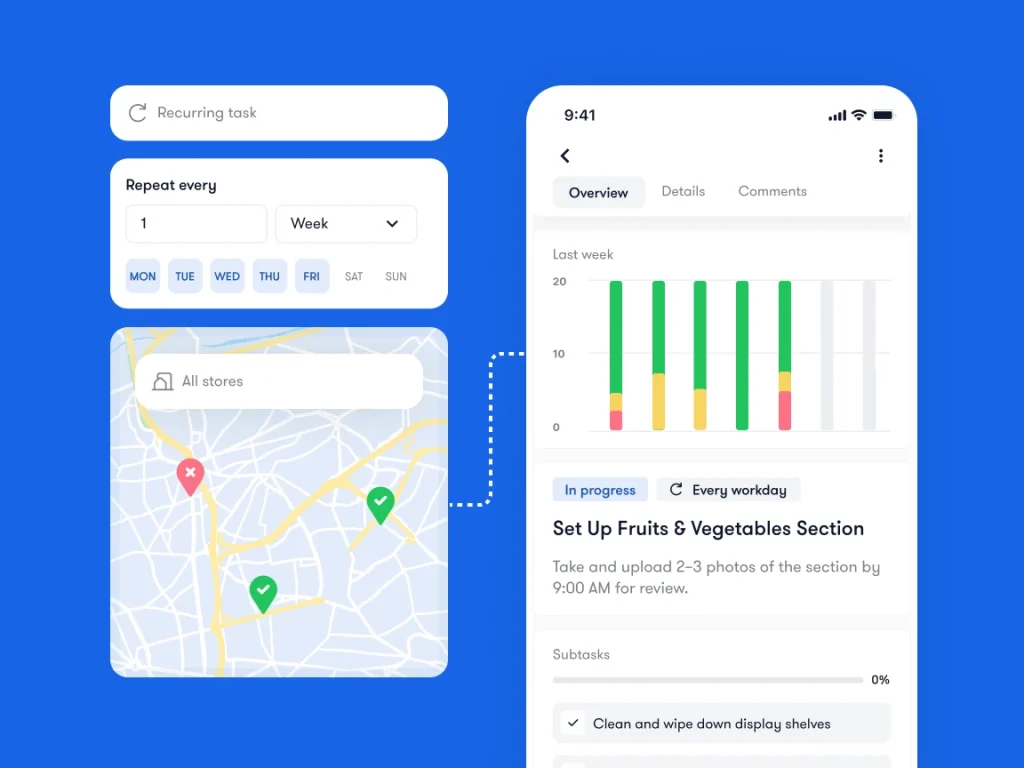
A photo can help a reviewer assess a finished display. Other work may need a different check, such as a record, a conversation or an observation on the floor. Choose evidence that fits the task instead of requesting a photo for everything.
For teams comparing tools, the retail task management software guide explains which workflows to evaluate. A Bitreport demo can start with one recurring store routine and how your team currently assigns, completes and checks it.
Make the role description specific to your store
Before using a generic list of duties in recruitment or a performance review, adapt it to the actual job. Name the store format, reporting line, team structure and decisions the manager is authorized to make.
Describe the results expected, then clarify the work and support behind them. If the manager owns stock availability, explain their part in replenishment and which allocation decisions remain central. If they own team development, provide time for coaching and a route for additional training.
Finally, agree what a useful handover and escalation look like. When responsibilities, decision limits and follow-up are clear, the store manager and the team can carry the work from one shift to the next without relying on the same person to remember every detail.