

A retail sales audit checks whether recorded sales transactions are complete, accurate and supported by the relevant payment and transaction records. It covers issues such as missing transactions, cash differences, refunds, voids and price overrides.
Store teams also need to check what caused an exception. Repeated price overrides might lead back to an expired shelf label. An item with no sales might be unavailable on the shelf. These are related store-execution checks, with different evidence and owners from transaction reconciliation.
This guide connects the two: how to review sales records, what to inspect in the store, and how to follow a finding through to a verified correction across multiple locations.
What is a retail sales audit?
In retail systems, sales auditing focuses on transaction accuracy. Oracle’s Sales Audit overview describes reviewing point-of-sale (POS) and order-management transaction data and balancing totals at cashier, register or store-day level.
A store day means the transactions assigned to one location’s business day. Agree the business-date cutoff before comparing records; a late trading session may not align with the calendar date on a bank deposit.
Our broader retail audit guide covers store standards and operations. A sales audit has a narrower starting point: whether sales and related transactions were recorded correctly. An in-store inspection can then help explain the exceptions.
| Review | Main question |
|---|---|
| Transaction sales audit | Are the sales records complete and correct? |
| Tender reconciliation | Do payment records and counted funds agree? |
| Sales-floor execution check | Are prices, products and promotions correct in-store? |
| Sales performance review | What explains changes in sales results? |
Keep these reviews connected without treating them as interchangeable. A tidy display does not establish that a register balances. A balanced register does not establish that customers saw the correct price.
Start with comparable records
Choose the store, business date, register or session, and sales channels included in the review. Record the currency and whether each amount includes tax, discounts or refunds. Match those definitions before treating a difference as an error.
Gather the records that apply to your process:
POS transaction and tender reports for the selected period, including returns, voids, discounts and overrides.
Register-session records, opening cash, closing counts and documented cash additions or removals.
Payment-provider reports and settlement references for card or other non-cash payments.
Relevant order, receipt and refund references, plus required approval records.
The approved price or promotion instructions for any in-store checks prompted by the audit.
Check that the expected data arrived before reviewing its totals. A register with no imported transactions may be missing a file rather than reporting no sales. Identify the missing register or batch and assign the investigation to the team responsible for the data feed.
Oracle’s sales-audit operations documentation separates import, validation and export. That distinction matters operationally: data being present, data passing checks and data reaching the next system are separate events.
Run the retail sales audit in five steps
Use a repeatable process, with finance or the sales-audit team owning transaction decisions and store teams supplying the evidence and physical corrections they control. The following workflow is a practical starting structure to adapt to your systems.
Check cash over or short
For a cash session, compare the amount physically counted with the expected amount at the same point in the closing process. Shopify’s cash-tracking documentation illustrates this expected-versus-counted comparison and separates opening and closing discrepancies.
Use the register system’s definition of expected cash. Confirm how it handles the opening float, refunds and recorded cash movements; do not count an adjustment twice or compare a pre-removal total with a post-removal count.
With counted cash minus expected cash as the sign convention:
Cash over or short = counted cash − expected cash
For a fictional session with $620 expected and $600 counted, the result is −$20: a $20 shortage. Recheck the count and supporting movements under your cash-handling procedure. Do not change the expected figure simply to remove the difference, or assume the shortage establishes theft.
Review non-cash payments and settlements separately
A day’s card sales and a bank deposit are not automatically comparable totals. Match the relevant payment or settlement references and account for the transactions included in that batch.
Stripe’s payout reconciliation documentation explains how automatic payouts relate to batches containing payments and other transactions, including refunds and fees. It also distinguishes payout timing from transaction dates. Use your provider’s equivalent records rather than expecting the bank deposit to equal the day’s gross card sales.
Route unresolved payment differences to the responsible finance or payments team. The store may need to provide a receipt or terminal reference, but it should not have to guess an accounting adjustment.
Retail sales audit checklist
Use two linked checklists: one for the transaction review and one for the store checks it prompts. Record the result, reference, owner and next action for each failed check. An item that was not checked should remain distinguishable from one that passed.
Transaction and register checks
Completeness: Are the expected stores, registers, sessions and channels represented? Investigate missing or duplicated transaction identifiers.
Cash: Does the closing count match expected cash at the same stage of the process? Are relevant cash movements documented?
Non-cash payments: Can exceptions be traced to the corresponding provider record, refund or settlement reference?
Returns and refunds: Are the original transaction references, reasons and approvals available where required by policy?
Voids and cancellations: Is the reason recorded, and was the action taken by someone with the required authority?
Discounts and overrides: Do changes have the required reason and approval, and do repeated exceptions point to a wider problem?
Corrections and completion: Is the authorized change traceable, and has the designated reviewer confirmed the outcome?
Keep thresholds and approval rules specific to your organization. A high return or override count can justify a closer look, but the count alone does not explain whether the activity was appropriate.
Store sales and merchandising checks
Inspect the product and location connected to the finding. A useful store check compares the physical situation with an approved standard, rather than asking whether the department “looks good.”
Shelf prices: Does the correct product’s shelf label agree with the approved price and the price returned by the POS check? Confirm pack size, variant and promotion conditions.
Product availability: Is the item available in its expected selling location? If it is missing, distinguish stock elsewhere in the store from an unavailable delivery or incorrect stock record.
Promotional displays: Are the products, offer, artwork and campaign dates consistent with the current brief?
Planogram execution: Are products in the required positions and facings, with a recorded reason for any authorized exception?
Customer-facing corrections: Have outdated labels or displays been corrected, and has the reviewer checked the result?
For a broader store visit, our retail audit checklist covers operational standards beyond these sales-related checks. Keep that inspection separate from the financial reconciliation record.
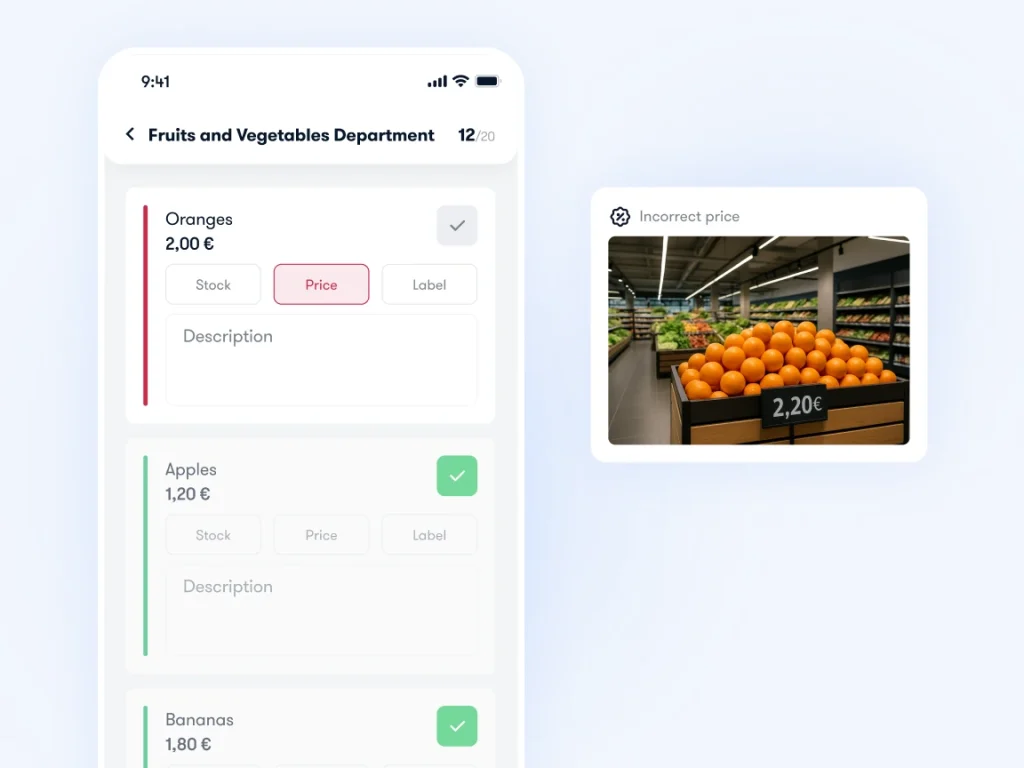
Example: repeated price overrides lead to a shelf correction
Imagine a fictional store where the same product receives repeated manual price overrides. The approved offer has ended, but a promotional label remains on the shelf. A cashier’s adjustment may resolve the immediate customer issue while the outdated label keeps generating new ones.
Here is how the sales-audit team and the store can close the issue together:
A photo is useful evidence of the label correction. It does not by itself show which price the register charged, so retain the appropriate POS check or transaction reference as well.
Decide who owns each part of the audit
The store manager should know which questions the store can answer and which need head-office action. An exception log works best when responsibility is explicit.
| Owner | Typical responsibility |
|---|---|
| Finance / sales audit | Transaction review and approved reconciliation decisions |
| Store manager | Counts, local evidence and assigned store corrections |
| Pricing / merchandising | Approved offers, price configuration and display instructions |
| IT / payments | Data-feed or payment-system investigation |
| Area manager | Recurring execution issues across locations |
Adapt the role names to your organization. For sensitive corrections, follow your approval and separation-of-duties rules. Avoid leaving the person making an adjustment to approve their own work where independent review is required.
For each finding, record a stable reference, store, business date, affected register or product, observed difference, supporting evidence, responsible person, deadline and review outcome. Keep financial and personal data in the approved systems with appropriate access; a general store task should contain only what the assignee needs to act.
Retail sales audit best practices for multiple stores
Use shared definitions. Agree what counts as a refund, void, override, open exception and completed review. Compare stores using the same period and definitions, and note any differences in systems or coverage.
Set the cadence by the work. A practical starting point is to review transaction completeness and register exceptions after the relevant close, inspect promotions at launch and changeover, and review recurring findings across stores weekly. Adjust timing to your processing schedule and risk; this is not a universal audit frequency requirement.
Prioritize findings by potential customer impact, amount, urgency and recurrence. A small price error repeated across many stores may need a central fix. A missing data feed needs attention before a store can be fairly compared with the rest of the network.
Retain the original record and use authorized correction routes. Document what changed, why, who changed it and who reviewed it. A cleared warning without an explanation gives the next reviewer little evidence to work with.
Check whether a correction addresses a local mistake or a shared cause. Replacing one label will not fix an incorrect campaign file sent to every location. Conversely, a correct head-office instruction will not remove a label that was left behind in one store.
Measures that help you manage sales-audit follow-up
Choose measures that lead to a decision. Keep transaction exceptions separate from store-execution failures, and define the population reviewed before comparing results.
Transaction exception rate
Count unique transactions with at least one flagged exception, rather than counting several flags on the same transaction as several transactions.
Transaction exception rate (%) = flagged transactions ÷ transactions reviewed × 100
Use consistent rules and coverage over time. A change in the checks being run can change this rate even when store behavior stays the same. The measure identifies review workload and patterns; it is not a fraud rate.
Sampled price-match rate
For a store check, define a match as the correct product’s shelf label and POS check agreeing with the current approved price and conditions.
Sampled price-match rate (%) = matching items ÷ items checked × 100
Report the sample size and selection method. Checking only previously failed items does not describe price accuracy across the entire store. For either percentage, report “not applicable” when nothing was reviewed rather than dividing by zero.
Open exceptions and age
Track unresolved findings by owner and how long they have been open. Separate items awaiting store evidence from those awaiting a central decision. Review overdue work and repeat findings together to decide whether the next action is a local correction, a clearer instruction or a system investigation.
Choose software for the part of the process you need
For transaction reconciliation, evaluate whether the system can work with your actual POS, order and payment records, identify incomplete data, apply your review rules and preserve a traceable correction history. Test how exceptions reach the responsible reviewer and how approved results move to downstream systems. Confirm those capabilities for the specific implementation rather than assuming every POS report supplies a full sales-audit process.
For in-store execution, evaluate mobile checks, product and location references, photo evidence, task ownership, deadlines and review. Our retail audit software comparison focuses on this operational side.
Bitreport supports store audits, assigned corrective tasks and photo review, with AI checking available for eligible clients and industries. Its price-control workflow helps teams record price, label and availability issues during store checks and follow up on the work. It is not a replacement for POS reconciliation, a payment processor or a financial ledger.
Start with one recurring exception, such as repeated overrides on a promotional line. Agree who reviews the transaction, who checks the shelf and what evidence closes each action. Once that handoff is reliable, use the same process across the relevant stores.
Frequently asked questions
What is a retail sales audit?
A retail sales audit checks whether recorded sales transactions are complete, accurate and supported by the relevant payment and transaction records. It covers issues such as missing transactions, cash differences, refunds, voids and price overrides. Store checks on prices, products and promotions then help explain what caused an exception.
How often should you run a retail sales audit?
Set the cadence by the work. A practical starting point is to review transaction completeness and register exceptions after the relevant close, inspect promotions at launch and changeover, and review recurring findings across stores weekly. Adjust the timing to your processing schedule and risk; this is not a universal audit frequency requirement.
Who is responsible for a retail sales audit?
Finance or the sales-audit team owns transaction decisions. Store teams supply the evidence and the physical corrections they control, pricing or merchandising owns approved offers and price configuration, IT or payments investigates data feeds, and the area manager watches recurring issues across locations. Where independent review is required, the person making an adjustment should not approve their own work.
Does a flagged transaction mean someone did something wrong?
No. A flagged transaction is a question to investigate, not proof of misconduct. Separate missing data, recording errors, authorized adjustments and items that still need an explanation. A cash shortage does not by itself establish theft, and the transaction exception rate describes review workload, not a fraud rate.