
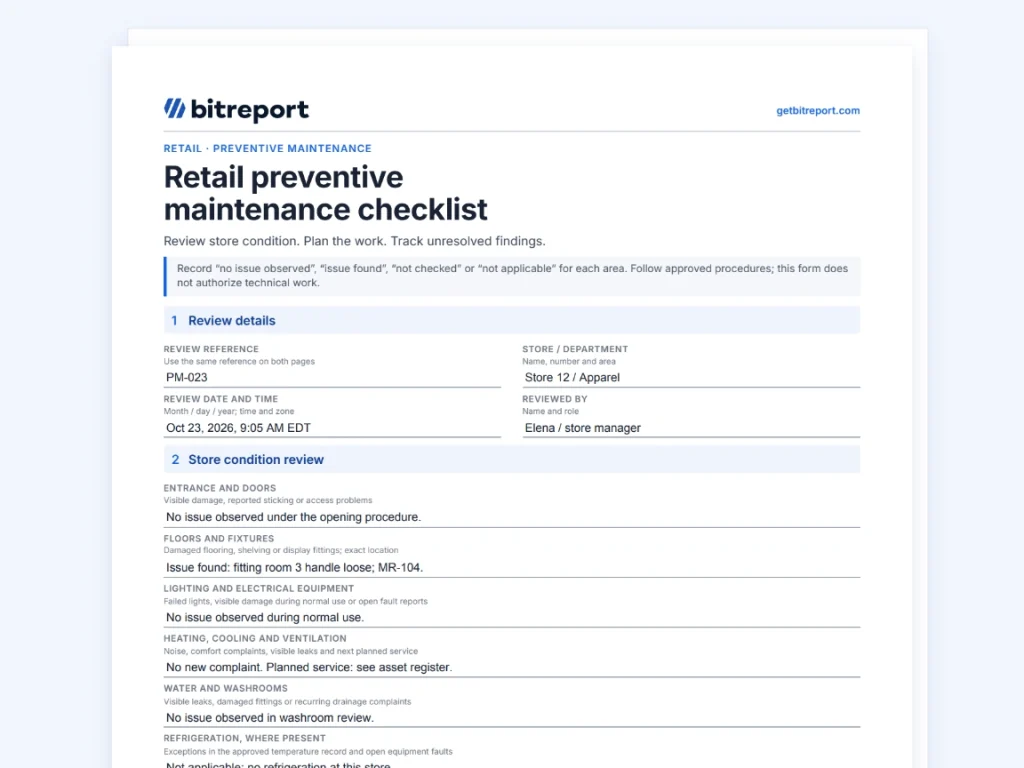
A retail preventive maintenance checklist helps a store team spot deterioration, keep planned servicing on schedule and follow up on faults before they become repeat disruptions. It should identify the asset or area, the check or maintenance task, who is responsible, when it is due and what happens if a problem is found.
The useful distinction is between checking condition and carrying out maintenance. A store colleague can report a damaged fitting during a walk-through. Repairing it may require a trained employee or contractor. A completed walk-through does not prove that the repair or scheduled service happened.
This guide connects those two parts of retail operations, with a downloadable checklist, a way to set the schedule and a worked example of following a finding through to closure.
Download the retail preventive maintenance checklist

The two-page PDF includes a store condition review and a repeatable asset maintenance record. Use the first page for the areas covered by your store’s agreed checks. Copy the second page for each asset or planned task that needs its own interval, owner, completion evidence or follow-up.
The form can be filled on a computer or printed. Before use, add the relevant manufacturer instructions, service arrangements and site requirements. It is a coordination record; technical service sheets and required inspection reports remain separate. Check that all entered text is visible before printing or sharing the completed file.
What to include in a retail maintenance checklist
Start with the assets and spaces the store actually has. An apparel shop and a supermarket may share doors, lighting and shelving, but the supermarket also needs equipment-specific refrigeration routines. Mark an area “not applicable” when it is absent, rather than letting an empty field look like a completed check.
The following areas help structure the review. The observations are prompts for staff following an approved procedure, not instructions to test, dismantle or repair equipment.
| Area | Store-level observation or record to check |
|---|---|
| Entrance and doors | Visible damage, a reported sticking door or an unresolved access problem |
| Floors and fixtures | Damaged flooring, shelving or display fittings; exact location of the defect |
| Lighting and electrical equipment | Failed lighting, visible damage noticed during normal use, and open fault reports |
| Heating, cooling and ventilation | Unusual noise, comfort complaints, reported leaks and the next planned service |
| Water and washrooms | Visible leaks, damaged fittings or a recurring drainage complaint |
| Refrigeration, where present | Exceptions in the approved temperature record and open equipment faults |
| Stockroom and handling equipment | Reported damage, equipment unavailable for use and outstanding inspection records |
| Fire and life-safety arrangements | Access obstructions, reported faults and the status of required inspection records |
Record what was observed, not a technical diagnosis. “Water visible beneath unit AC-04” gives the maintenance team a location and symptom. “Drain pump failed” is a diagnosis that the observer may not be qualified to make.
For each applicable area, record no issue observed, issue found or not checked. If the check could not be completed, give the reason and the next owner. An inaccessible area is not a pass. Where food, fire, electrical or other specialist procedures apply, those procedures determine the response; this general checklist does not replace them.
Separate store checks from planned service work
The store checklist and the maintenance schedule answer different questions. The checklist asks, “What condition did we find?” The schedule asks, “Which maintenance activity is due, and who will do it?” A fault discovered during a planned check can generate corrective work as well as a change to the next preventive task.
UK HSE guidance on maintaining work equipment emphasizes planning work from the manufacturer’s instructions and using people competent to carry it out. In a retail workflow, translate that into a clear boundary between observation, approved routine care and specialist work.
Store team: observe, record and report
Give colleagues a short set of checks they understand, including what to look for and who to contact when something is wrong. They should know which routine activities they are trained and authorized to perform. Do not turn a generic checklist into permission to open electrical panels, adjust safety devices or access equipment at height.
A store manager also coordinates access: the location of the asset, trading hours, the contact on site and any restrictions the maintenance team needs to know. Keep keys, access codes and other sensitive details in the retailer’s approved channel, not a widely shared checklist.
Maintenance owner: plan the work and verify the result
The facilities or maintenance owner defines the task and required competence, confirms who is responsible and obtains the relevant service record. This may involve the retailer, a contractor or the landlord. Record the named contact for a landlord-managed asset rather than treating “landlord responsibility” as the end of the store’s follow-up.
A visit booking is not proof that a service was completed. Keep the report reference, work completed, outstanding recommendations and next due date. If the technician leaves an unresolved finding, assign it separately instead of closing the entire record because the visit took place.
Set the maintenance schedule from the asset requirements
Do not copy a daily, weekly and monthly schedule onto every asset. HSE’s equipment inspection guidance links inspection frequency to risk assessment, manufacturer recommendations, operating conditions and experience. It also cautions against collecting so much routine detail that checks become superficial.
For each planned activity, record the interval and where that interval came from. This could be a manufacturer manual, a service plan or a requirement identified by the responsible facilities professional. Use the applicable local requirements as well; a contract calendar alone is not evidence that every required inspection has been covered.
A practical schedule can contain several kinds of entry without assuming that they share a frequency:
Store observations attached to an approved opening, closing or walk-through routine.
Equipment servicing based on the relevant instructions and agreed maintenance plan.
Required specialist inspections tracked with their own dates and reports.
Seasonal readiness reviews before a change in operating conditions or trading hours.
For example, extended holiday trading hours can justify asking the facilities owner to review the heating and lighting schedule. ENERGY STAR’s commercial-building guidance recommends reviewing operating schedules and documenting control changes. The store team can flag the change in hours; authorized personnel decide and record any adjustment.
Keep the original due date when a task is missed. Add the reason, interim arrangements where applicable and a revised commitment. Replacing the date without recording the delay makes an overdue service disappear from the review.
A worked example: a finding during a planned store review
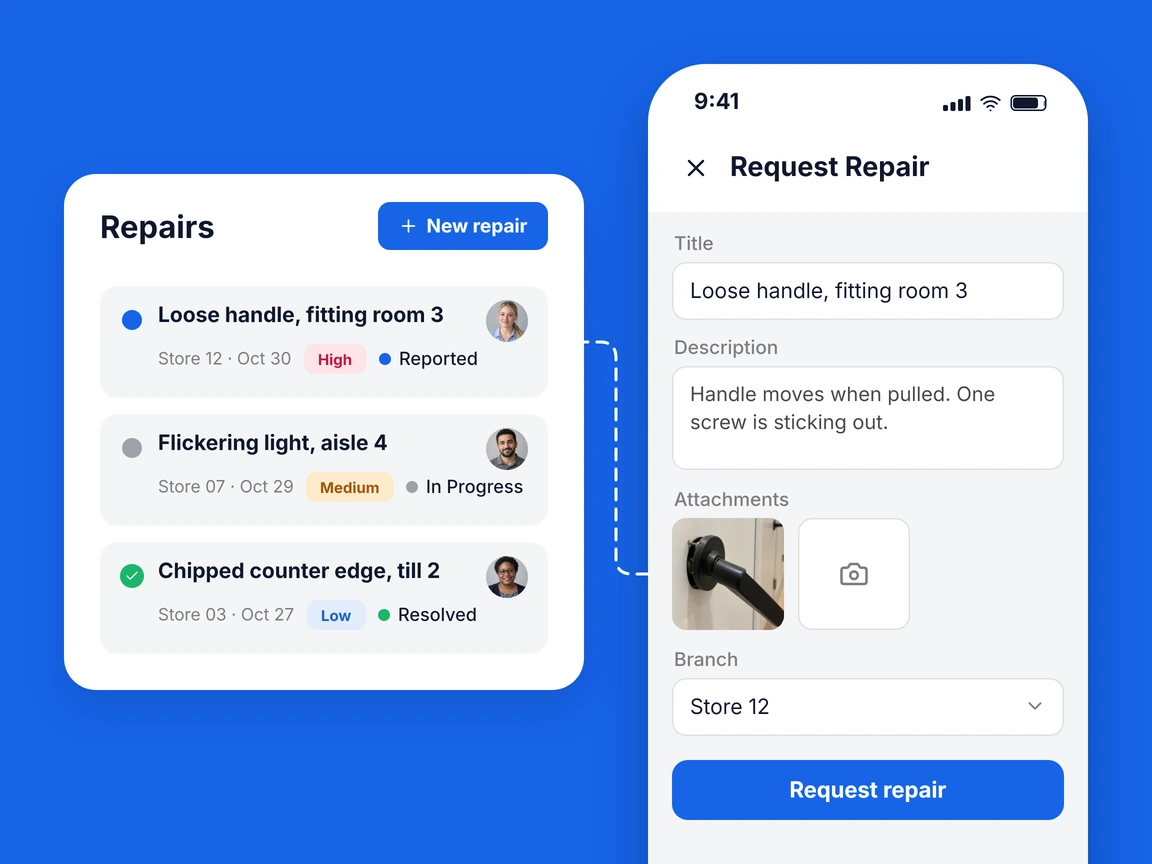
Imagine a store manager notices that the fitting-room door handle on asset FR-03 has become loose. The following example is illustrative; the asset, people, references and dates are invented. Its purpose is to show how the checklist connects to the repair record.
The planned condition review can be recorded as completed with a finding while MR-104 remains open. Keeping those two statuses separate prevents a completed checklist from hiding an unresolved repair.
Turn findings into repair follow-up
A useful repair record gives the recipient enough information to act: store, exact location or asset ID, observed symptom, operational impact, reporter, supporting evidence and the next update due. Link it to the checklist so the person reviewing the store does not have to search a chat thread for the latest position.
If the observation involves an immediate hazard, use the store’s immediate response procedure and contact the responsible person. Do not leave it waiting for the next scheduled checklist review. If an event also needs an account of what happened, use a separate retail incident report, linked to the repair rather than copied into it.
With Bitreport repair resolution, store teams can report issues with photos and details, assign responsibility and track progress through resolution. The checklist records the check; the issue record keeps the repair’s current status and follow-up visible.
For planned work, use recurring store tasks with instructions and deadlines. Keep technical service requirements and specialist reports alongside the relevant maintenance records; a task marked complete does not establish that an asset meets every applicable requirement.
Review overdue work and recurring faults across stores
An operations review should look beyond whether colleagues submitted the checklist. Start with overdue planned work, unresolved findings and repairs that have been reopened. A site with complete checklists and several unresolved faults still needs attention.
Group repeat reports by asset and symptom where the records allow it. Three reports about the same fitting can indicate one unresolved problem, repeated deterioration or inconsistent closure. Read the history before deciding which explanation fits. Do not count every new report as a separate equipment failure.
Compare similar stores and equipment types. A large grocery store will have different maintenance needs from a small fashion store. Use the differences to improve the plan: clarify a vague check, identify missing service evidence or ask the responsible specialist whether an interval needs review. Maintenance records should lead to a better next decision, not simply another completed form.
Frequently asked questions
How often should a retail preventive maintenance checklist be completed?
Use the schedule set for the specific check or asset. Store observations can form part of approved daily routines, while servicing and specialist inspections follow their own requirements. Record the source of each interval; there is no single frequency suitable for all retail equipment.
Can store employees carry out preventive maintenance?
They can carry out tasks for which they have the necessary competence, training and authorization. Give them clear instructions and escalation routes. Observing and reporting a fault does not authorize a repair, adjustment or specialist inspection.
Is this checklist a replacement for an inspection certificate?
No. It helps coordinate checks, planned work and follow-up. Where a formal inspection or service report is required, retain that record and link it to the relevant asset and task. A completed general checklist is not a substitute.
What is the difference between preventive and corrective maintenance?
Preventive maintenance is planned work intended to reduce deterioration and failures. Corrective maintenance addresses a fault that has been found. A preventive check may reveal a problem and create corrective work; the check and the repair should retain separate statuses until each is complete.