

A restaurant can look ready from the dining room while the next shift inherits missing supplies, an unresolved equipment fault, and a delivery problem nobody owns. An internal audit gives the manager a structured way to find those gaps and make sure they are corrected.
A restaurant audit checklist is a set of observable checks covering how a location runs: food-handling controls, cleanliness, equipment, service, team readiness, stock routines, and management follow-up. Each failed check should lead to a specific finding, a responsible person, and a way to verify the fix.
Use this guide to define your audit scope, choose useful checks, record results consistently, and follow issues through to closure. It includes a compact sample rather than a long form to copy blindly into every restaurant.
Decide what kind of restaurant audit you need
An internal operations audit asks whether the restaurant is working to its agreed standards. It can cover the guest experience, kitchen routines, equipment, records, and management controls. A shift checklist directs daily work; an audit tests whether that work is happening and whether the standard is effective.
A health inspection has a different purpose and authority. Regulators assess applicable legal requirements. An internal checklist does not replace that inspection, a site-specific food-safety plan, or any required records. A financial audit also requires a separate scope; checking a closing handover does not verify the restaurant’s accounts.
For US food-safety criteria, use the rules adopted by the relevant authority and your approved procedures. The FDA Food Code is a model used by jurisdictions to develop their rules; adoption and local requirements can differ. Have your responsible food-safety lead approve the criteria that apply to your menu and processes.
Before a visit, record the location, date, shift, auditor, manager on duty, checklist version, and areas included. State what you could not observe. A quiet pre-opening walkthrough cannot tell you how the team handles an order change during a busy service.
For the broader management system around the audit, see our restaurant operations guide.
Restaurant audit checklist: eight areas to cover
Start with a shared core across locations, then add modules for the work each site actually performs. A café preparing sandwiches and a full-service kitchen will not need identical checks. Keep each question narrow enough that two auditors can interpret it the same way.
The table below is a sample of audit questions, not a complete food-safety inspection or a substitute for your operating procedures. Extend it with your approved requirements and evidence rules.
| Audit area | Example observable check | Evidence to record |
|---|---|---|
| Food-handling controls | Are the required monitoring records for the sampled process complete, with deviations handled under the approved procedure? | Process, record period, observation or measurement, and linked corrective action |
| Cleaning and sanitation | Has the selected cleaning task been completed to the documented method, with the result checked? | Area or item inspected, observed condition, relevant record, and any follow-up |
| Equipment and facilities | Does the sampled equipment operate as required, and is an unresolved defect assigned to an owner? | Equipment identifier, fault description, current operating restriction, and repair reference |
| Stock and receiving | Can the team show how the most recent sampled delivery discrepancy was recorded and resolved? | Delivery reference, discrepancy, owner, and final disposition |
| Guest areas and service | Are the sampled tables and service stations ready to the restaurant’s current standard? | Area inspected, specific gap, and observation time |
| Order and menu consistency | Does a sampled order pass through the required handoff and reach the guest as intended? | Order reference without customer details, observation, and any handoff failure |
| Team readiness | Can the person assigned to a sampled task explain the current procedure and where to get help? | Role, procedure version, coaching need, and assigned follow-up |
| Management follow-up | Is a previously closed audit issue still resolved when checked again? | Prior finding, present observation, and reason for reopening if needed |
Avoid a single question such as “Kitchen clean and safe?” It combines several standards, gives no clear failure reason, and encourages a quick tick. Specify the item, the expected condition, and the evidence needed.
Food-handling checks should be tailored to the operation, including the applicable controls for staff hygiene, cross-contamination, allergens, storage, preparation, and time/temperature management. Use the approved limits and methods in the restaurant’s procedures. This article does not supply a universal set of cooking or holding temperatures.
Choose evidence that fits the question. A photograph can show a blocked access point or damaged fixture. It cannot establish a food’s internal temperature, prove that a cleaning chemical was used at the correct concentration, or demonstrate that a team member followed a process all shift.
Run the audit as a walkthrough, not a paperwork exercise
Follow the work through the restaurant. Start with the previous handover and open issues, walk the guest and preparation areas, observe a relevant process, and then compare what you saw with the records. Adjust the route so you do not interrupt a time-critical task or create a hazard.
A practical visit can follow five steps:
Set the scope with the manager. Confirm the audit version, activities taking place, areas to sample, and who will handle urgent issues. Review unresolved findings before starting.
Observe the actual work. Inspect the selected areas and watch the relevant task. Ask the person doing it to explain the procedure; avoid supplying the answer in the question.
Compare observations with records. Check that the log, checklist, or handover reflects what happened. Record the time and sample so someone else can understand the finding later.
Agree actions before leaving. Describe each failure, identify the responsible owner, set a deadline appropriate to the risk, and define the evidence required for closure.
Review the correction and check recurrence. Confirm the fix using the right evidence, then revisit repeated problems in the next audit or management review.
The FDA’s retail and food-service HACCP guidance emphasizes active managerial control: ongoing management of food-safety risks. A completed audit form supports that work, but the form alone is not the control.
Do not wait until the closing meeting to raise an urgent safety concern. Bring it to the person in charge immediately and follow the approved response procedure. The audit record should capture what was found and what happened next, without delaying necessary action.
Make sampling visible
Record which equipment, records, orders, shifts, and areas you inspected. “Three delivery records checked” is more useful than “Receiving checked.” If you cannot observe the dinner service during a morning visit, say so rather than assuming it passes.
Across multiple locations, use the same core definitions and rotate additional areas according to risk and previous findings. Keep differences in scope visible when comparing restaurants. A short opening check and a full operational visit should not appear as equivalent audits in a league table.
Score consistently without hiding serious findings
Use response options that separate a failure from a missing observation. Define the rules before the audit, rather than adjusting them afterward to make a location’s score look reasonable.
| Result | Meaning | How to handle it |
|---|---|---|
| Pass | The observed condition meets the defined requirement | Record the evidence required for that item |
| Fail | The observed condition does not meet the requirement | Record the finding and a corrective action |
| Not applicable | The requirement genuinely does not apply to this location or activity | Give the reason; review inconsistent use across sites |
| Not observed | The requirement applies, but was not assessed during this visit | Keep it incomplete and arrange the needed check |
If you use an unweighted pass rate, calculate it only from assessed, applicable items and show the unassessed count beside it:
Assessed-item pass rate = passed items ÷ (passed items + failed items) × 100
For example, a fictional visit with 32 passes, four failures, two items not applicable, and two not observed has an assessed-item pass rate of 88.9%. It still has four failures and two unanswered checks. Calling that a completed “89% compliant restaurant” would overstate what was established.
Separate critical findings from the overall percentage. A serious safety issue needs the appropriate immediate response even if every presentation check passes. Define criticality and escalation with the people responsible for safety and operations; do not let a general scoring formula decide whether service can continue.
If you weight questions, document the weights and keep them consistent within the same audit version. Preserve the original result after correction. Otherwise, a report can lose the distinction between what the auditor found and what the team fixed later.
Turn findings into specific corrective actions
A useful finding describes the gap without blaming the team or prescribing a vague reminder. Compare “Poor handover” with “The evening shift’s unresolved delivery discrepancy had no owner in the opening handover.” The second version tells the manager what needs attention.
For each failure, keep the original check, observed condition, responsible owner, due time, required correction, and closure evidence together. Record a reviewer where a second check is needed. For equipment faults, connect the action to the repair record so the restaurant does not maintain separate, conflicting updates; our restaurant equipment maintenance guide covers that workflow in more detail.
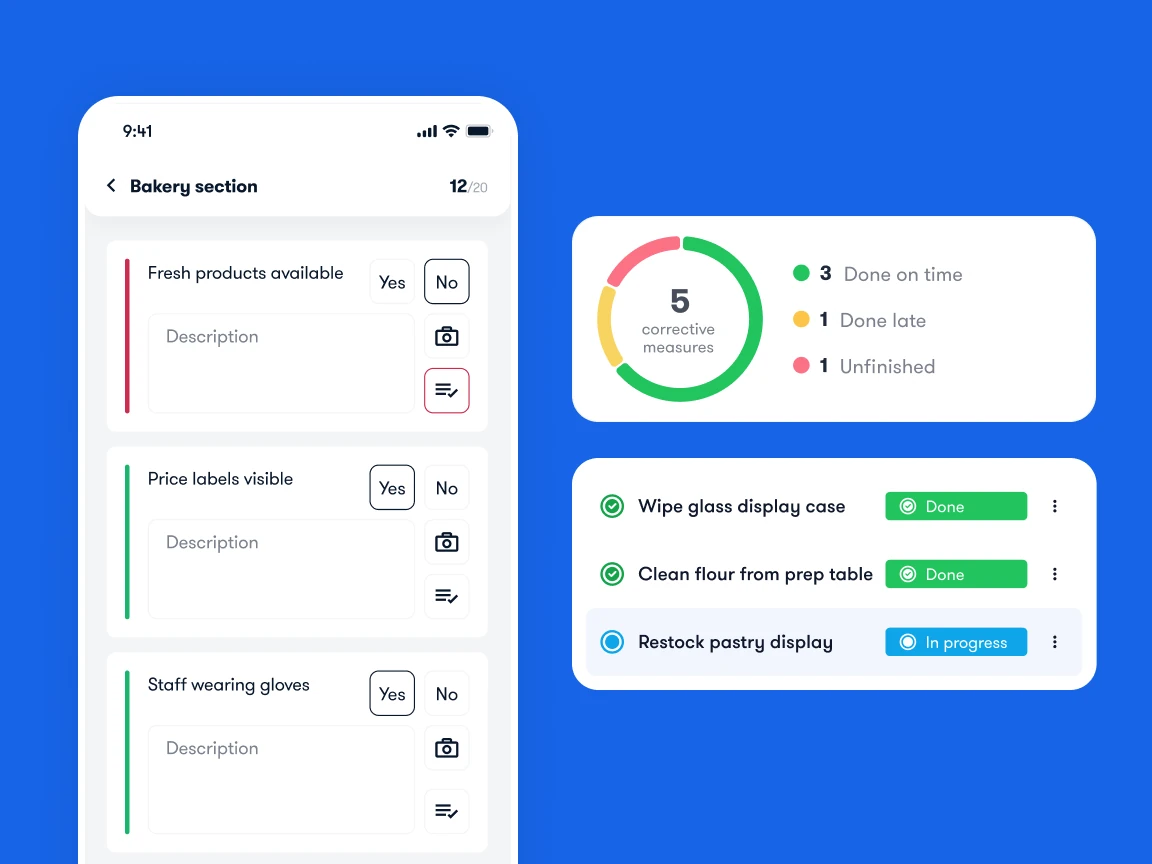
Bitreport’s audits and checklists workflow connects failed checks with assigned corrective tasks, deadlines, and evidence. The existing product visual illustrates that connection; its bakery questions and example counts are not a prescribed restaurant safety standard or customer results.
Example: the same delivery issue keeps returning
Imagine a restaurant group where two consecutive visits find an unresolved short delivery missing from the shift handover. This is a fictional operational example.
The first correction is to reconcile the delivery discrepancy and give the follow-up a named owner. The wider question is why the issue disappears between shifts. The manager discovers that the receiver writes it on a paper delivery note, while the closing manager uses a separate handover record.
The team adds a delivery-exception field to the handover, assigns who transfers unresolved items, and explains the change to both shifts. The reviewer then checks the next relevant delivery and handover to see whether the new routine works.
“Staff reminded” would not establish that the handoff improved. Evidence of the next correctly handled exception is stronger. If the problem recurs, reopen the action and investigate the routine rather than recording another identical reminder.
Use daily checklists as evidence between audits
An audit should connect to the routines that keep the restaurant running between visits. Opening and closing records can show what the shift checked, what remained unfinished, and who inherited the follow-up. They are supporting evidence, not proof that every box reflects the actual condition.
For those routines, Bitreport’s existing café and restaurant opening and closing checklist provides 43 items across eight sections. It includes arrival, kitchen and bar, front of house, team readiness, closing records, and lock-up. It is an opening/closing template, not a complete restaurant audit form.

Adapt the template to your location and approved procedures before use.
Use a small sample of completed records in the audit and compare them with current conditions. Missing entries should remain visible. A checklist filled in later from memory does not provide the same evidence as a check recorded when the work took place.
Set a review rhythm that matches the operation
There is no single internal audit frequency that fits every restaurant. Distinguish routine shift checks from a broader manager self-audit and an area-manager review. Then choose the cadence according to the operation’s risks, changes, and recurring findings.
As a starting point, an operator might use opening/closing checks each shift, review unresolved actions in a weekly management meeting, and schedule broader visits according to location risk. These are planning examples, not regulatory intervals. Required food-safety monitoring and statutory inspections follow their own rules.
For multi-location reporting, keep the results actionable: which critical findings remain open, which actions are overdue, which problems recur, and which required checks were not observed. Compare like-for-like audit versions and similar scopes before drawing conclusions about branch performance.
A location with more recorded issues may be reporting more honestly rather than operating worse. Review the evidence and sample coverage alongside the score. Reward early reporting and verified resolution so managers do not learn to hide failures to protect a ranking.
Make the next audit easier to act on
Before adding more questions, review your existing form. Keep checks that lead to an observation, decision, or action. Split ambiguous questions, remove duplicates, and identify where the team needs better instructions or a clearer handover.
Try the revised checklist at one location and ask two reviewers to assess a small shared sample. Differences in their answers reveal wording or evidence rules to improve before rolling the form out more widely. Keep a version history so changes do not silently distort comparisons.
If your group is moving beyond paper and spreadsheets, our food safety audit software guide explains how to evaluate inspection, evidence, and corrective-action workflows. Bring a real checklist and one recurring issue to a Bitreport demo to see how the work can move from a failed check to an assigned action and reviewed evidence.