

To improve customer service in retail, give employees clear service standards, accurate product information and the authority to solve routine problems. Practice difficult conversations, make help available during busy shifts, and follow up on issues until the customer knows the outcome.
A reminder to “be more helpful” gives a store team little to work with. An employee needs to know what to say when an item is unavailable, who can approve an exception and how to get support while other customers are waiting.
This guide sets out seven practical changes for store and regional managers, with example wording, a complaint-handling scenario and a first-month rollout plan. The aim is useful, consistent help throughout the shopping visit, without turning every conversation into a script.
1. Turn good service into observable standards
Start by choosing a recurring problem from customer feedback and manager observations. “Customers struggle to get help with product questions on weekend afternoons” is specific enough to investigate. “Our service needs work” is not.
Observe the conditions around the problem. Can employees find the answer? Is the knowledgeable colleague covering another department? Does a replenishment assignment leave nobody available to help? These questions connect service to the daily work covered in our retail operations guide.
Then describe what a colleague should do in that situation. Use standards that a manager can observe and coach:
| Service moment | Observable standard |
|---|---|
| Customer needs help | Acknowledge them and agree the next step |
| Product question | Confirm the need and check uncertain information |
| Another colleague is needed | Introduce the colleague and explain the issue |
| Follow-up is promised | Name the owner, contact method and update time |
Choose response expectations that fit the store and task. A customer comparing two appliances may need a longer conversation than someone asking where to find an item. A universal speed target can encourage employees to end useful conversations too quickly.
Keep the shared standard consistent across branches, while allowing the practical arrangement to vary. A small shop might call its duty manager directly; a large store might use a service desk and department specialist.
2. Ask about the customer’s need before recommending a product
A useful opening question gives the customer room to explain. “What will you be using it for?” tells an employee more than immediately describing the most expensive option. Follow with a relevant question about fit, compatibility, quantity or budget, then confirm what matters most.
For example, a shopper looking at storage boxes may need them to fit a particular shelf. The employee can check the measurements before discussing colors or suggesting a larger set. If the dimensions are uncertain, look them up or measure the item; a confident guess creates a problem later.
Give shoppers a choice about the interaction. Someone who wants to browse can be shown where to find help without being followed around the store. Ask how you can assist rather than assuming what help a person needs.
Teach staff to explain the reason for a recommendation and accept a refusal. “This smaller box fits the shelf depth you gave me” is useful advice. An unrelated add-on offered to meet a target can distract from the customer’s original task.
3. Put reliable answers and backup within reach
Identify the questions employees repeatedly bring to a manager: promotion exclusions, product compatibility, stock availability, delivery options or return procedures. Give each topic an owner responsible for keeping the approved information current and easy to find.
A short reference page is useful when it has a clear title, an effective date and the route for questions it cannot answer. Remove superseded copies from the places staff use. Test access on the shop floor, including with a newly hired employee, rather than assuming that uploading a document means people can use it.
Agree who provides backup during each shift and who covers that role during breaks. Before a promotion starts, brief staff on the offer, exclusions and escalation route. Check that the physical signs and checkout information tell the same story.
When a colleague needs to investigate, they can say: “I want to check that properly. I’ll ask our department specialist and come back to you.” Add a realistic update time if one can be given. If the answer takes longer, update the customer before leaving them to chase it.
At busy times, the manager must also protect service capacity. Assign who watches the queue, who can pause another task to help and who handles questions that require specialist knowledge. A communication course will not fix a shift with no available backup.
4. Give complaints an owner and a clear next step
A complaint needs a person who stays responsible for moving it forward, even when someone else must approve the solution. The customer should not have to restart the story with each colleague.
Business Queensland’s complaint-handling guidance recommends defining who can offer remedies, keeping those decisions within agreed limits and following up. Put the relevant authority and escalation route in the store’s approved procedure so employees know when they can act and when they need help.
Consider this illustrative situation: a shopper says an advertised offer did not apply at checkout. The employee has not yet established whether the item qualifies. A practical response has five parts:
These are example words and actions to adapt to the retailer’s approved process. They do not establish what remedy is owed in a particular dispute. Employees should know the route for checking applicable requirements rather than improvising a rule at the counter.
For a heated conversation, Shopify’s retail guidance emphasizes listening, clarification and a calm response. It also distinguishes difficult interactions from threats or harassment. Staff should follow the company’s safety and escalation procedure when an interaction becomes unsafe; solving a complaint should not require tolerating abuse.
5. Coach one real situation at a time
Use a recent service problem as a short practice exercise. Remove customer identifiers, describe the situation and ask two colleagues to act out the conversation. One person plays the customer; the other checks the need, explains the options and makes any necessary handoff.
Afterward, discuss a specific behavior. Did the employee clarify the issue before offering a solution? Did the next colleague receive enough context? Could the customer tell what would happen next? Try the exchange again with that one improvement.
Keep the practice close to the work. Before a new promotion, rehearse a question about its conditions. After repeated requests for the same product detail, check that staff can find the answer. A short quiz can test the procedure; a conversation or observation shows whether someone can apply it.
Our customer service training guide for retail employees covers the broader training program. Use these short exercises to reinforce that program during ordinary store routines, with time allocated by the manager.
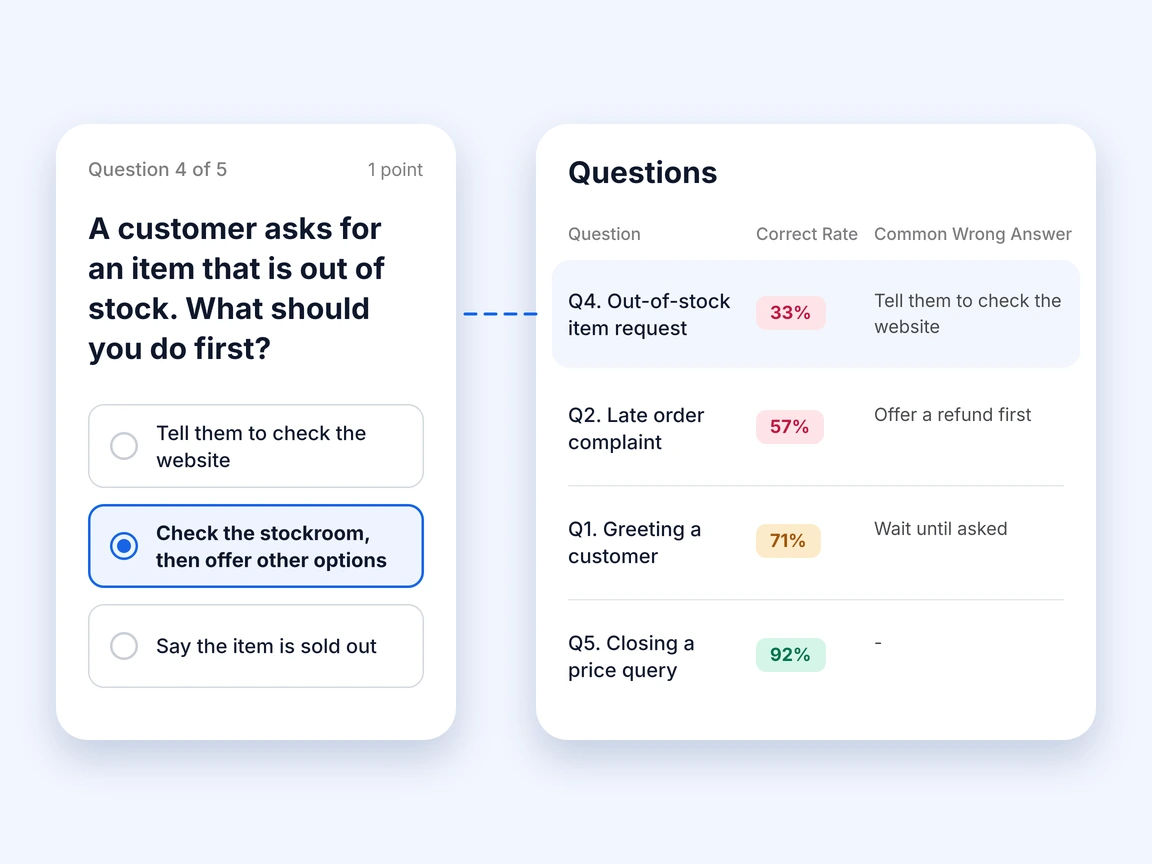
Bitreport’s microlearning supports short daily quiz sessions and shows learning results by person and question. Managers can use a frequently missed question to choose what to explain or practice next. Quiz results show knowledge gaps; they do not replace observing how employees help customers.
Give feedback privately and describe what happened, rather than labeling the employee. “You explained the next step clearly, but the customer did not know who would call back” points to a behavior they can change. Ask what made the interaction difficult before assuming more training is the only answer.
6. Make follow-up survive a change of shift
If a customer is waiting for a stock check, a decision or an answer from another team, the promise must remain visible after the original employee goes home. Record the issue, what has already been checked, the next action, its owner and the promised update time in the approved service record.
Keep necessary customer contact details in the system intended for customer follow-up. Store task records should contain only the operational information needed to complete the work. The next shift needs enough context to act, without copying personal details into every checklist or group chat.
Have the duty manager review commitments due during the shift and assign a replacement owner when someone is absent. If the team cannot deliver the promised answer on time, it should still give the agreed update and explain the next step.
Separate the customer’s case from the store correction. A refund decision may belong in the transaction or customer service system, while replacing a confusing sign is an operational task. Completing the sign change does not automatically mean the customer has been contacted.
7. Measure whether service actually becomes easier
Choose a measure that matches the problem you are trying to solve. For slow access to help, observe the time between a request and the start of assistance. For broken promises, review whether updates due during a defined period were delivered on time. Record the number of observations and use the same definitions when comparing shifts.
Ask customers about the specific interaction: for example, whether they received the help they needed and what could have been clearer. Include an opportunity to explain the answer. Use the same question and timing when comparing periods, and show how many people responded.
Review repeated contacts about the same unresolved issue. A case marked closed internally may still be unfinished from the customer’s perspective. Check the explanation given and any remaining action before counting it as resolved.
Avoid using sales or raw complaint totals as the only service score. Promotions and stock affect sales, while a team that starts recording complaints properly may initially report more of them. Compare similar periods and stores, and discuss what changed with the employees doing the work.
Our retail store analytics guide explains how to connect store measures with decisions. For service improvement, pair an operational measure with customer feedback so the team can see both what it did and whether that helped.
A practical first-month plan
Start with one recurring service issue in a small, representative group of stores. The following four-week sequence is a suggested working plan, not a promised time to achieve a result.
Better customer service comes from employees knowing how to help and having the support to do it. Choose one problem the team recognizes, make the next action clear and verify that the change works for customers as well as for the store.
Frequently asked questions
What is the first step to improving retail customer service?
Choose a recurring service problem supported by customer feedback or observation. Check whether the cause is unclear information, limited authority, unavailable support or a skill gap, then define the action and owner needed to address it.
How can retail staff help customers without being pushy?
Ask what the customer needs, explain relevant options and give them room to decide. Offer help with browsing or product questions, explain why a recommendation fits and accept a refusal without repeating the sales pitch.
Should every customer complaint go to the store manager?
No. Employees can handle issues covered by their approved authority. The manager or another designated colleague should take over decisions beyond that authority, uncertain cases and situations covered by the store’s escalation or safety procedure.
How can managers tell whether customer service training is working?
Check whether employees apply the intended behavior in practice and whether the relevant customer feedback improves. Use quiz results to identify knowledge gaps, but also observe conversations, handoffs and follow-up. Training completion alone does not prove better service.