

Customer experience in retail is the impression people form across their interactions with a retailer: finding information, visiting a store, choosing products, paying, collecting an order and getting help afterward. It includes how the visit feels and how easily the customer achieves what they came to do.
A helpful employee can make a difference. So can a product that is actually available, a clear price, an accessible aisle and a pickup order that is ready when promised. Customer experience depends on the work behind the interaction as well as the interaction itself.
For store and regional managers, the practical task is to identify where customers encounter friction, connect it to an operational cause and verify that the fix works. This guide explains the main touchpoints, useful measures and a way to turn customer feedback into better store routines.
Customer experience is broader than customer service
Customer service is the help a retailer provides before, during or after a purchase. Customer experience includes that help and everything around it. Qualtrics describes retail experience across the customer’s interactions and channels, rather than as a single conversation with an employee.
For example, a colleague may handle a price complaint politely. That is good service. If the shelf label is still wrong tomorrow, the underlying experience has not improved for the next customer.
The distinction matters because it changes who needs to act. Store teams handle the immediate interaction, but merchandising, inventory, digital, training and operations teams may own the cause. A customer should not need to understand your internal structure to get a consistent answer.
| Customer service focuses on | Customer experience also includes |
|---|---|
| Answering a product question | Whether product information is clear and accurate |
| Helping a shopper find an item | Whether the shelf, signs and stock records agree |
| Handling a complaint | Whether the same problem keeps affecting shoppers |
| Explaining a return | Whether the policy was clear before purchase |
| Handing over an order | Whether the pickup promise and store preparation match |
Why customer experience matters in retail
A customer who cannot find the advertised item may leave without buying it. Someone who waits for an order already marked ready may question the retailer’s next promise. These are specific failures to investigate, rather than reasons to assume every dissatisfied customer will behave the same way.
Good execution also reduces avoidable work for employees. Clear labels mean fewer price queries. Organized pickup storage means less searching. Consistent instructions reduce the need to call another manager for the same answer.
Across multiple stores, the challenge is consistency. Head office may define one standard, while customers encounter different versions depending on the location or shift. Retail operations turns those standards into repeatable work, with room for stores to report exceptions and local needs.
Six retail touchpoints to examine
Walk through a real shopping task from the customer’s perspective. Choose something concrete, such as finding a promoted item or collecting an online order. Observe what happens before offering a solution.
These touchpoints need not become six new reports. Start with the ones where feedback and observation show a repeated problem. Keep the evidence tied to a location, time and task so a manager can investigate it.
Example: the order was “ready,” but the customer had to wait
Imagine a shopper collecting a lamp after receiving a ready-for-pickup message. The employee is friendly, but the parcel is not in the collection area. A second colleague searches the stockroom, and the shopper waits while the queue grows. This is an illustrative scenario, not a reported customer case.
Telling the employee to smile more would miss the cause. The investigation should establish when the order was marked ready, whether the item had been set aside, where it was stored and who owned the handover between shifts.
Shopify’s pickup guidance distinguishes preparing and setting aside the items, notifying the customer and marking the order as picked up. The practical lesson is to test the physical preparation and the message together; a status change alone cannot prove the parcel is where the next colleague expects it.
An improvement might be a clearly identified pickup location, an agreed preparation check before notification and a shift handover for orders still waiting. The order system continues to own the transaction and notification. A store routine supports the people doing the preparation.
Verify the change by observing later pickups during comparable periods. Measure how long customers wait after arrival and record exceptions. A faster handover is useful evidence; it does not establish that every part of the customer relationship has improved.
Turn customer feedback into store-level action
Use feedback to locate the problem, then inspect the work around it. “Checkout was confusing” could mean unclear queue signs, a promotion that did not apply or an employee who could not explain the payment options. Those require different fixes.
Collect the details needed to investigate without adding unnecessary personal information to operational reports. The useful fields are often the store, approximate time, touchpoint, reported issue and responsible team. Keep customer contact details in the appropriate service system when follow-up is needed.
Bitreport’s audits and checklists help store teams record checks and follow up on corrective work. Managers can review evidence and outstanding tasks across locations. This supports the operational part of improving customer experience; it is not a customer survey platform, CRM or order management system.
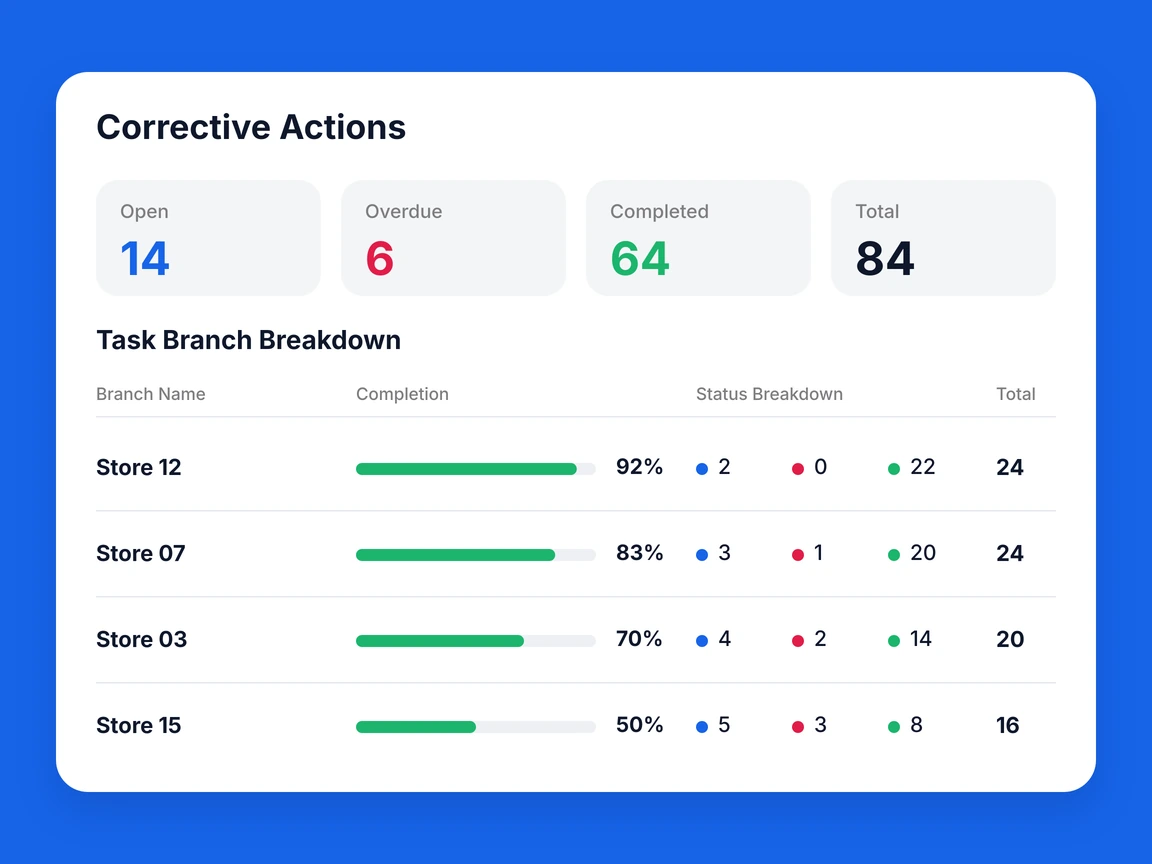
A store audit can confirm whether a display was replenished or a label corrected. Ask customers or observe the journey to learn whether the shopping task became easier. Keep both forms of evidence in view rather than treating a high audit score as a satisfaction score.
How to measure customer experience in retail
Combine customer feedback with a small number of operational measures. Choose measures that help explain a specific journey, rather than collecting scores without an owner or a next action.
Ask about a specific experience
Customer satisfaction score, or CSAT, can summarize responses to a defined interaction. For a pickup survey, ask about that pickup rather than asking a broad brand question and attributing every answer to the store team.
On a five-point satisfaction scale, Qualtrics calculates CSAT using ratings of 4 and 5 as satisfied responses:
CSAT (%) = (Responses rated 4 or 5 ÷ Valid responses to that question) × 100
For an illustrative set of 50 valid responses, 40 ratings of 4 or 5 produce a CSAT of 80%. With no responses, report no data rather than 0%. Show the response count alongside the score.
Keep the question, scale and survey timing consistent when comparing periods. Respondents may differ from people who do not answer, and a small number of responses can shift sharply. Use comments and observations to investigate the score rather than treating it as the view of every visitor.
Measure the friction behind the feedback
For a pickup problem, record the time from the customer’s arrival or check-in to handover, using the same start and finish points each time. Review typical waits and unusually long cases, with the number of observed pickups and the trading period.
For repeated price complaints, count confirmed shelf-to-checkout discrepancies within the same check scope. For unresolved complaints, review how long cases remain open and whether the customer received the agreed follow-up. These measures help diagnose work; they are not interchangeable satisfaction scores.
Avoid ranking stores by raw complaint totals alone. A busier store has more opportunities for complaints, and one team may be better at recording them. Compare similar conditions and consider transaction or visitor volume when it is measured reliably.
Keep commercial outcomes separate from proof of cause
Conversion, repeat purchases and returns can add context, but promotions, stock availability, seasonality and customer mix also affect them. A sales increase after a training session does not by itself prove that the session caused the increase.
Our retail store analytics guide explains how to connect store measures with decisions. For customer experience work, define the problem first, establish a baseline and check whether both the operational friction and the relevant customer feedback change.
Keep standards consistent across locations
Write the core standard in terms that a store team can act on. For pickup, that might mean the order is physically prepared and locatable before the ready message is sent. Define who checks it and what to do when the promise cannot be met.
Allow local execution where conditions differ. A small store and a large branch may need different collection points or staffing arrangements. They can still share the same customer promise and verification criteria.
Give employees access to the current procedure and practice the exceptions, not just the ideal interaction. A colleague should know what to do when the item is missing, the price differs or the usual manager is unavailable.
Review recurring issues across stores with the team that owns the underlying process. A repeated question may call for a clearer policy; a repeated stock discrepancy may require inventory investigation. More reminders will not solve every cause.
For the broader governance and feedback program, continue with our customer experience management strategy guide. Start local improvement with one journey, an accountable owner and a clear way to verify what changed.
Frequently asked questions
What is an example of good customer experience in retail?
A customer finds accurate product information, locates the item or prepared order, understands the price and completes the visit without avoidable confusion. If something goes wrong, the retailer gives a clear next step and follows through. Good service contributes to the experience, alongside stock, signs, systems and store routines.
Is customer experience the same as customer service?
No. Customer service is the help provided during an interaction. Customer experience includes that help and the wider journey, including finding information, browsing, checkout, pickup and returns.
Can a store audit measure customer satisfaction?
An audit measures the standards and conditions included in the check. It can reveal problems likely to affect a visit, but it does not directly measure how customers felt. Combine operational checks with customer feedback and observation.
What should a retailer improve first?
Start with a recurring problem supported by feedback or observation, such as pickup delays or price confusion. Identify the cause and owner, test a correction in representative stores, and compare the same measures before expanding it.