

In the fast-paced world of retail, the gap between head office strategy and in-store execution is often where profit is lost. You might have the perfect planogram, the ideal sales script, and a marketing campaign designed to turn heads, but if it isn’t happening on the floor, it doesn’t exist. This disconnect is the primary reason why high-level strategies fail to generate bottom-line results.
To bridge this gap, successful retailers rely on the retail audit. It is the eyes and ears of the organization, providing the data necessary to align vision with reality. However, modern auditing is no longer just about policing compliance; it is about empowering store teams, optimizing operations, and ensuring a seamless customer experience.
What is a Retail Audit?
At its core, a retail audit is a systematic examination of store operations, merchandising, and compliance standards. It is a health check for your business, diagnosing issues before they become terminal problems. Unlike a casual store visit, an audit is structured, data-driven, and actionable. It serves as a critical tool for identifying whether a specific location is adhering to the brand’s established standards and operational protocols.
While the term is often used interchangeably with a retail store inspection, it helps to understand the nuances. Inspections often imply a pass/fail safety check, whereas an audit is comprehensive, looking at the qualitative and quantitative aspects of store performance. It captures the “feel” of the customer experience alongside the hard data of inventory levels.
Defining the Retail Audit
A retail audit assesses the health of a brand’s presence in physical locations. It involves collecting data on inventory levels, sales volume, competitor activity, planogram compliance, and in-store pricing. The goal is to gather business intelligence that allows store managers and district leaders to make informed decisions. According to recent internal audit best practices, a robust program must be fully integrated across the enterprise, combining compliance, risk, and continuous improvement into a single ecosystem rather than treating audits as isolated events.
The Scope of Store Audits
The scope can vary wildly depending on the objective. A merchandising audit focuses strictly on product presentation and stock levels. A loss prevention audit targets security protocols and cash handling. A health and safety inspection ensures the physical environment is safe for staff and customers. Modern audits often blend these elements into a “Total Store” audit to maximize the efficiency of the district manager’s visit.
Who Conducts the Retail Audit?
Audits are generally conducted by one of two parties. Internal audits are performed by district managers, regional directors, or dedicated audit teams employed by the retailer. These are useful for coaching and immediate correction. External audits are conducted by third-party agencies or mystery shoppers. These provide an unbiased, “customer-eye” view of the store, free from internal politics or existing relationships with store staff.
Why Retail Audits Are Non-Negotiable
In an era where e-commerce offers perfect consistency, physical retail must work harder to compete. A store operations check is non-negotiable because it is the only way to guarantee that the brand promise made in marketing materials is kept at the point of sale. Without audits, a retail chain is essentially operating on hope rather than data.
Furthermore, the economic landscape demands efficiency. As noted in Fitch Ratings’ 2026 outlook, softness in discretionary goods is putting pressure on retailers to tighten operations. In this climate, identifying operational bottlenecks and resource wastage through audits isn’t just a “nice to have” – it is a survival mechanism.

Ensuring Brand Consistency
Whether a customer walks into a store in New York or London, the experience should feel familiar. Brand consistency builds trust. If one store is pristine and another is cluttered, the brand equity is diluted. Regular audits ensure that visual merchandising standards, employee uniforms, and cleanliness protocols are uniform across all locations. This unified front is essential for retaining loyal customers who expect a specific standard of service.
Improving Operational Efficiency
Audits uncover the hidden inefficiencies that bleed profit. Are staff spending too much time searching for stock in a disorganized backroom? Is promotional signage being set up late, missing the peak sales window? By moving away from anecdotal evidence (“I think the store looks good”) to quantifiable data metrics, head office can identify systemic issues. If 40% of stores fail a specific checklist item, it suggests a training issue or a flaw in the process, not just individual store failure.
Data-Driven Decision Making
Modern retail is about the customer experience (CX). A recent 2026 Retail Consumer Study by Forsta highlights that while trust is growing, it remains guarded. Consumers need confidence that retailers are delivering value and utilizing technology responsibly. Audits provide the data to back this up. By monitoring product availability and store cleanliness, retailers can directly impact the metrics that drive customer satisfaction scores (CSAT) and Net Promoter Scores (NPS).
Types of Retail Audits
To get the most out of your field team, it is important to categorize your audits. A “catch-all” audit can be overwhelming and unfocused. Breaking them down allows for specialized attention to critical areas.

Merchandising Audits
A merchandising audit is perhaps the most common form of retail check. It focuses on the visual presentation of the store. Auditors check planogram compliance to ensure products are on the correct shelves and facings are optimized. They verify that pricing labels are accurate and present, and that promotional signage is current. This audit directly correlates to sales performance; if the product isn’t displayed correctly, it won’t sell.
Operations Audits
Operational audits dig into the backend processes that keep the store running. This involves reviewing inventory levels to prevent out-of-stocks or overstocks. It also includes checking staff scheduling to ensure peak times are covered, reviewing cash handling procedures, and ensuring that opening and closing checklists are being completed daily.
Loss Prevention Audits
Loss prevention (LP) audits are critical for margin protection. These audits identify theft risks, both internal and external. Auditors review security camera functionality, alarm systems, and high-theft item placement. They also scrutinize voided transactions and refund logs to detect potential internal fraud. In a tight economy, reducing shrinkage is often the fastest way to improve profitability.
Competitive Analysis Audits
Sometimes, the audit isn’t about you – it’s about “them.” Competitive audits involve visiting competitor locations in the local trade area. Retailers analyze competitor pricing strategies, promotional offers, store layouts, and customer service levels. This intelligence helps local store managers adjust their tactics to win market share.
How to Conduct an Effective Retail Audit
Conducting an audit is not simply walking around with a clipboard. It requires preparation, execution, and follow-through. To streamline this process, many retailers are turning to digital solutions. For example, using audits and checklists via a mobile platform ensures data is captured accurately and instantly.

Step 1: Define Your Objectives
Before sending anyone into the field, you must define clear KPIs. What are you trying to measure? Are you launching a new product and need to verify compliance? Are you trying to reduce slip-and-fall accidents? Setting clear objectives ensures that the audit yields actionable data rather than just noise.
Step 2: Design the Questionnaire
The quality of your data depends on the quality of your questions. Avoid vague “Yes/No” questions where detailed input is needed. Instead of asking “Is the store clean?”, ask “Are floors free of debris and scuff marks?” or “Are windows free of smudges?” Use a mix of scoring mechanisms, such as 1-5 scales, to allow for nuance. A well-designed store audit checklist guides the auditor through a logical flow of the store.
Step 3: Schedule and Execute
Consistency is key. Audits should be scheduled regularly – whether weekly, monthly, or quarterly – depending on the store’s risk profile and performance history. During execution, auditors should document findings with photos and notes. This prevents “he said, she said” disputes later on. Digital tools streamline this phase significantly by allowing photo evidence to be attached directly to specific questions.
Step 4: Analyze and Act
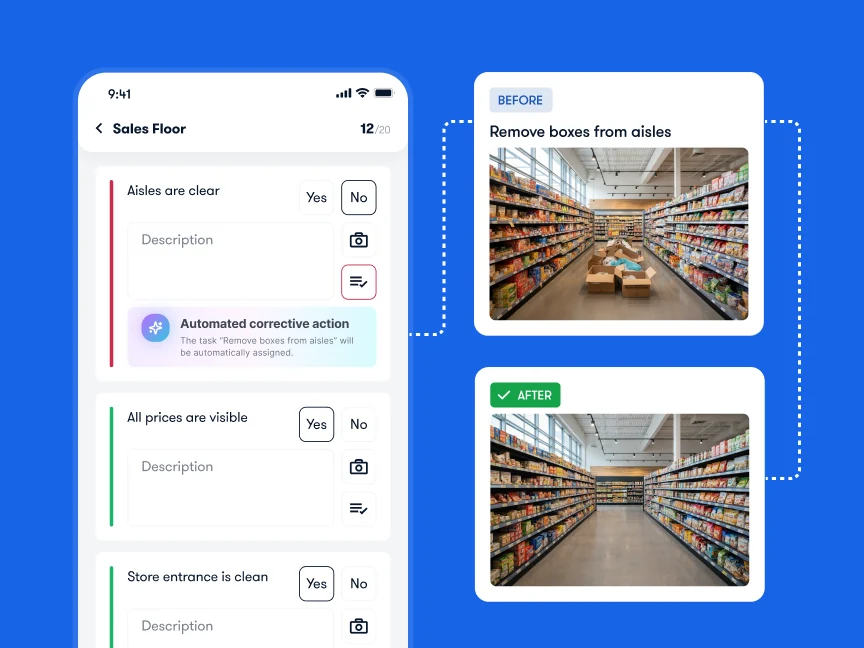
Data without action is vanity. The most critical step is closing the loop. Audit findings must be turned into assigned tasks for store managers. If a fixture is broken, a maintenance ticket should be triggered. If merchandising is incorrect, a task to reset the bay must be assigned. Head office should analyze trends across districts to identify broader training needs.
The Essential Retail Audit Checklist
While every retailer is unique, certain elements are universal. A comprehensive retail compliance audit covers four main zones: Exterior, Sales Floor, Staff, and Backroom. For a more detailed breakdown, you can access the retail store visit checklist.

Exterior and Entrance
The customer’s journey begins before they enter. Check the condition of exterior signage (is it lit? is it clean?). Inspect window displays to ensure they match current campaigns. Verify that the parking lot is free of litter and that the entrance is welcoming and unobstructed. This is your curb appeal.
Sales Floor and Merchandising
This is where the money is made. Check aisle clearance – are pathways blocked? Inspect lighting – are any bulbs out? Review product facing and zoning (is stock pulled to the front?). Verify that price tags are present and accurate. Check that promotional materials are placed according to the planogram.
Staff and Customer Service
Your people are your brand ambassadors. Check for uniform compliance and grooming standards. Observe interactions – are staff greeting customers upon entry? Do they possess adequate product knowledge? Are they using active selling techniques? This section is often qualitative but crucial for CX.
Inventory and Backroom
A chaotic backroom leads to a chaotic sales floor. Check for organization and labeling of overstock. Ensure safety hazards (blocked fire exits, stacked boxes) are addressed. Verify stock rotation processes (FIFO – First In, First Out) are being followed to prevent spoilage or obsolescence.
Modernizing Audits: The Shift to Digital Tools
The days of paper checklists and Excel spreadsheets are numbered. Paper audits lead to data lag; by the time the report reaches head office, the data is weeks old. Furthermore, manual data entry is prone to human error. To combat this, leading retailers are adopting audits and automatic corrective measures to centralize data for instant visibility.
The Problem with Paper and Spreadsheets
Paper forms are static. They cannot require a photo for a failed item, nor can they timestamp a location to prove the auditor was actually at the store. Compiling paper reports into a district-wide view requires hours of administrative work. This delay prevents agile decision-making.
Benefits of Mobile Audit Software
Mobile apps allow auditors to carry their tools in their pockets. They enable features like GPS validation, digital signatures, and mandatory photo evidence. If a store scores below a certain threshold, the software can automatically flag the district manager. This immediacy transforms the audit from a historical record into a real-time management tool.
Real-Time Reporting and Analytics
With SaaS platforms, data is aggregated instantly. Head office can view a dashboard showing compliance scores across the entire chain in real-time. They can drill down into specific regions or specific checklist questions (e.g., “Why are 30% of stores failing the ‘Window Display’ check?”). This analytic capability allows for rapid pivots in strategy.
Best Practices for Sustainable Auditing
To ensure your retail store inspection program delivers long-term value, it must be sustainable. It shouldn’t be a source of dread for store managers but rather a tool for support.
Avoiding Audit Fatigue
Don’t audit just to audit. Ensure every visit adds value. If store managers feel they are constantly under the microscope without receiving support, morale will drop. Combine audits with coaching sessions. Use the data to help them, not just to judge them.
Fostering a Culture of Improvement
Position audits as training opportunities. When a store fails a section, use it as a teaching moment. Explain why the standard exists (e.g., “We keep this aisle clear for ADA compliance and safety,” not just “because HQ said so”). Celebrate high-performing stores to boost morale and create healthy competition.
Continuous Calibration
The retail market changes fast, and your audit criteria should too. Regularly review your checklists to ensure they match current market trends and company priorities. Calibrate your auditors to ensure that “clean” means the same thing to the District Manager in the North as it does to the District Manager in the South.

Conclusion
Retail audits are the backbone of successful chain operations. They bridge the gap between strategy and execution, ensuring that the brand vision is realized in every customer interaction. By moving from manual, sporadic checks to strategic, digital-first auditing processes, retailers can ensure compliance, reduce losses, and significantly improve the customer experience. Whether you call it a retail compliance audit or a store health check, the goal remains the same: excellence in execution.